
By Adamu Yusuf
The Minister of State for Agriculture and Food Security, Dr. Aliyu Sabi Abdullahi, has reaffirmed the Federal Government’s commitment to repositioning the cooperative sector as a key driver of economic transformation through a comprehensive reform programme.
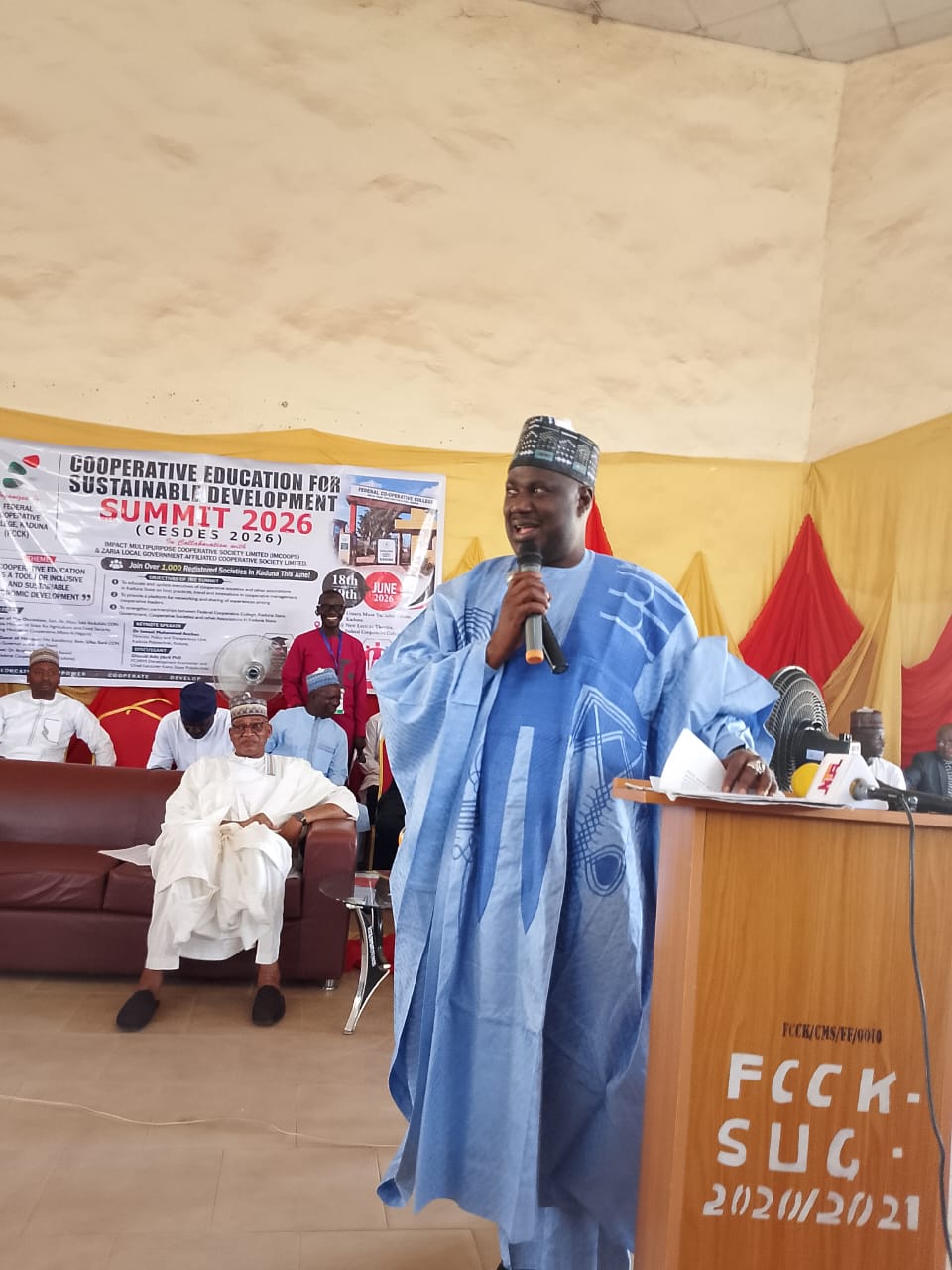
During his address at the Summit on Cooperative Education for Sustainable Development in Kaduna, Dr. Abdullahi described cooperative education as a critical tool for promoting inclusive and sustainable economic development, saying it remains essential to building strong and resilient cooperative institutions.
The summit, themed “Cooperative Education as a Tool for Inclusive and Sustainable Economic Development,” was organised by the Federal Cooperative College, Kaduna, in collaboration with the International Cooperative Society Limited (INCOPS) and other partners.
The minister commended the organisers for their dedication to advancing cooperative education and capacity building, noting that continuous stakeholder engagement was necessary to achieve meaningful reforms within the sector.
According to him, cooperatives remain among the most effective grassroots economic institutions in Nigeria, serving millions of farmers, traders, artisans, transport operators, civil servants, women, youths and vulnerable groups across the country.
He stressed that the rapidly changing global economy requires cooperative societies to become more knowledge-driven, technologically enabled, professionally managed and inclusive to remain relevant and competitive.
Dr. Abdullahi disclosed that the Federal Ministry of Agriculture and Food Security is implementing the National Cooperative Reform and Revamp Programme, a five-year agenda designed to reposition the cooperative sector as a major contributor to national development and economic prosperity.
He explained that the programme is anchored on seven strategic pillars, including governance and legal reforms, access to affordable finance, digitalisation and data management, capacity building, value-chain development, inclusion of women, youths and persons with disabilities, as well as strategic partnerships and investments.
The minister revealed that nationwide advocacy and stakeholder engagement campaigns had already commenced to build consensus around the implementation of the reform agenda, adding that the response from stakeholders had been encouraging.
Highlighting the government’s immediate priorities, Dr. Abdullahi announced plans for the digital transformation of the cooperative sector through the establishment of a National Cooperative Digital Architecture Platform, which will enhance transparency, accountability and access to reliable data.
He said the initiative would facilitate the creation of a National Cooperative Smart Registry, the issuance of Cooperative Verification Numbers (CVN) for societies and Cooperative Member Identification Numbers (COPID) for individual members, thereby strengthening regulatory oversight and improving access to finance.
The minister also disclosed plans to establish the Cooperative Bank of Nigeria, which he said would be owned and driven by cooperative societies to provide affordable financial services and support economic activities within the sector.
Earlier in his welcome address, the Provost of the Federal Cooperative College, Kaduna, Dr. Awwal Ibrahim Mohammed, described cooperative education as a vital instrument for addressing poverty, unemployment, inequality, food insecurity and financial exclusion in Nigeria.
Dr. Mohammed said cooperative societies provide people-centred solutions to development challenges by empowering individuals and communities to actively participate in economic activities, while promoting entrepreneurship, financial inclusion, food security and social cohesion.
He reaffirmed the commitment of the college to producing skilled cooperative professionals and expressed optimism that the summit’s deliberations would generate actionable recommendations capable of strengthening the cooperative movement and advancing sustainable economic development in Nigeria.