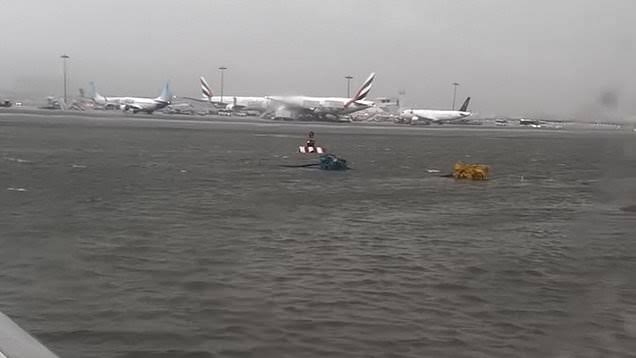

Heavy rain has been battering Gulf states, causing flash floods that have killed 20 people and disrupting flights at the world’s second-busiest airport.
Dubai Airport said it was facing “very challenging conditions” on Wednesday. It advised passengers not to turn up as runways were inundated with water.
Further north, a man died when his car was caught in flash floods.
Authorities also warned that more thunderstorms, heavy rain and strong winds were forecast, with many low-lying areas still under water.
No deaths were reported in Dubai, but an elderly man was killed when his vehicle was swept away in a flash flood in Ras al-Khaimah.
Although the rain had eased by Tuesday evening, Dubai International Airport warned on Wednesday morning that “recovery will take some time”.
The intense storm that began on Tuesday morning and continued through most of the day forced the airport to suspend operations for 25 minutes, divert several inbound planes and cancel a number of inbound and outbound flights.
Emirates, one of the UAE’s two flag carriers and the world’s largest international airline, meanwhile told customers that check in’s had been suspended at the airport for all flights until midnight.
The United Arab Emirates, Oman’s northern neighbour, experienced on Tuesday its largest rainfall event since records began 75 years ago.
In Oman, more than 1,400 people have been evacuated to shelters. Schools and government offices have been closed as a precaution.I
More than double the amount of rain expected in a year fell in just one day.
The heavy rain also hit Saudi Arabia and Bahrain, where videos showed cars stranded in flooded roads.
There are reports that recent “cloud-seeding” in the skies above the UAE might have caused the record-breaking event, but BBC Weather meteorologist Matt Taylor says the storm had already been predicted by forecast models.
The rainfall was caused by an area of low pressure centred to the south of the Arabian Peninsula, which pulled warm, moisture-laden air in to the region from the Indian Ocean south of Oman, he adds.
Many factors contribute to flooding, but a warming atmosphere caused by climate change makes extreme rainfall more likely.
BBC