Illiteracy is among the key agents that brings set back on Government initiatives of uplifting living standard of the people.
It is against this background that correspondent Khadija Aliyu from Kano, conducted a research on measures taken by Governments at all levels to eradicate illiteracy
Scholars define literacy as the ability to read and write. It can also be seen as competence or knowledge in a specified area.
Research indicates that, literacy is a key skill and a key measure of a populations education Despite large improvements in the expansion of basic education and the continuous reduction of education inequalities,there are substantial challenges ahead.
The poorest countries in the world,where basic education is most likely to be a binding constraint for development,still have large segments of the population who are illiterate.
In Nigeria,the national commission for mass literacy,adult and non formal education is the statutory federal government parastatal, charged with responsibility of making literate all those who for one reason or the other did not or cannot benefit from the formal school system.
The Kano state agency for mass education was established in April 1980 as an autonomous body, with the primary aim of eradicating illiteracy, provision of continuing education and to serve also as source of public enlightenment in the state.
The Institute offers literacy, vocational and enlightenment programs for adults, across the 44 local governments.
Dr. Halima Rabi’u Muhammad is the executive secretary of the Kano state agency for mass education, she spoke extensively to Radio Nigeria on how the agency witnessed transition since inception.
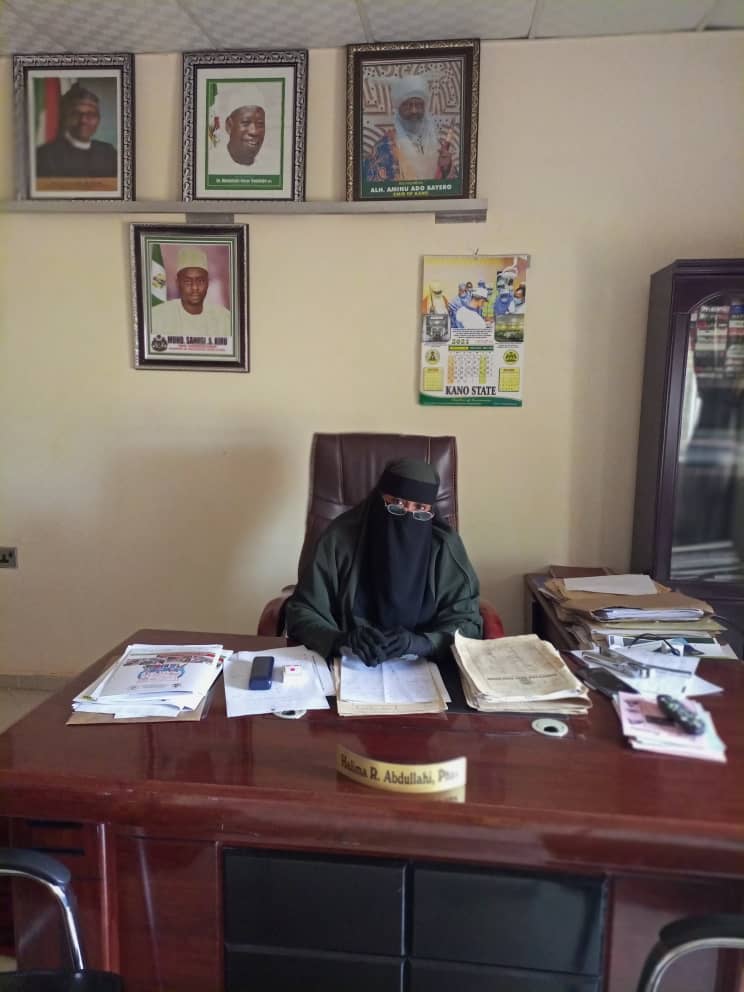
“The agency won two international literacy awards in 1981 and 1992. Conducted mass literacy campaign in 1993 where 2,200 classes were established with an enrolment of 66,000”
She explained that, the schools had a total number of 9,232 enrollees undergoing various programs.
The executive secretary pointed out that 52 learning centers with 339 full time and 273 part time facilitators are spread across the 44 local government areas in the state.
Dr. Halima sheds more light on training and retraining of staff including capacity building workshops on methodology and psychology of adult learners for all facilitators and supervisors.
She noted that women constitute a high percentage of learners at the centers and reaffirmed the agency’s commitment to the welfare of facilitators through the increament
of monthly allowences.
“All our programs are free as you know education in Kano is free and compulsory So, even before then Learners do not pay for anything including learning materials”
The Executive Secretary reiterated the kano State Government and National commission for mass literacy, adult and non formal education’s readiness to the provision of infrastructures and learning materials to move adult education to international standard.
KHADIJAH ALIYU/ KANO