
Writing By Daniel Karlmax, Editing By Godwin Duru
A Kaduna-based Islamic scholar and education expert, Professor Yahaya Muhammad Mujahid has stated that schools should not be treated as business enterprises aimed at generating profit, but rather as institutions for imparting knowledge, instilling morals, and providing direction to future generations.
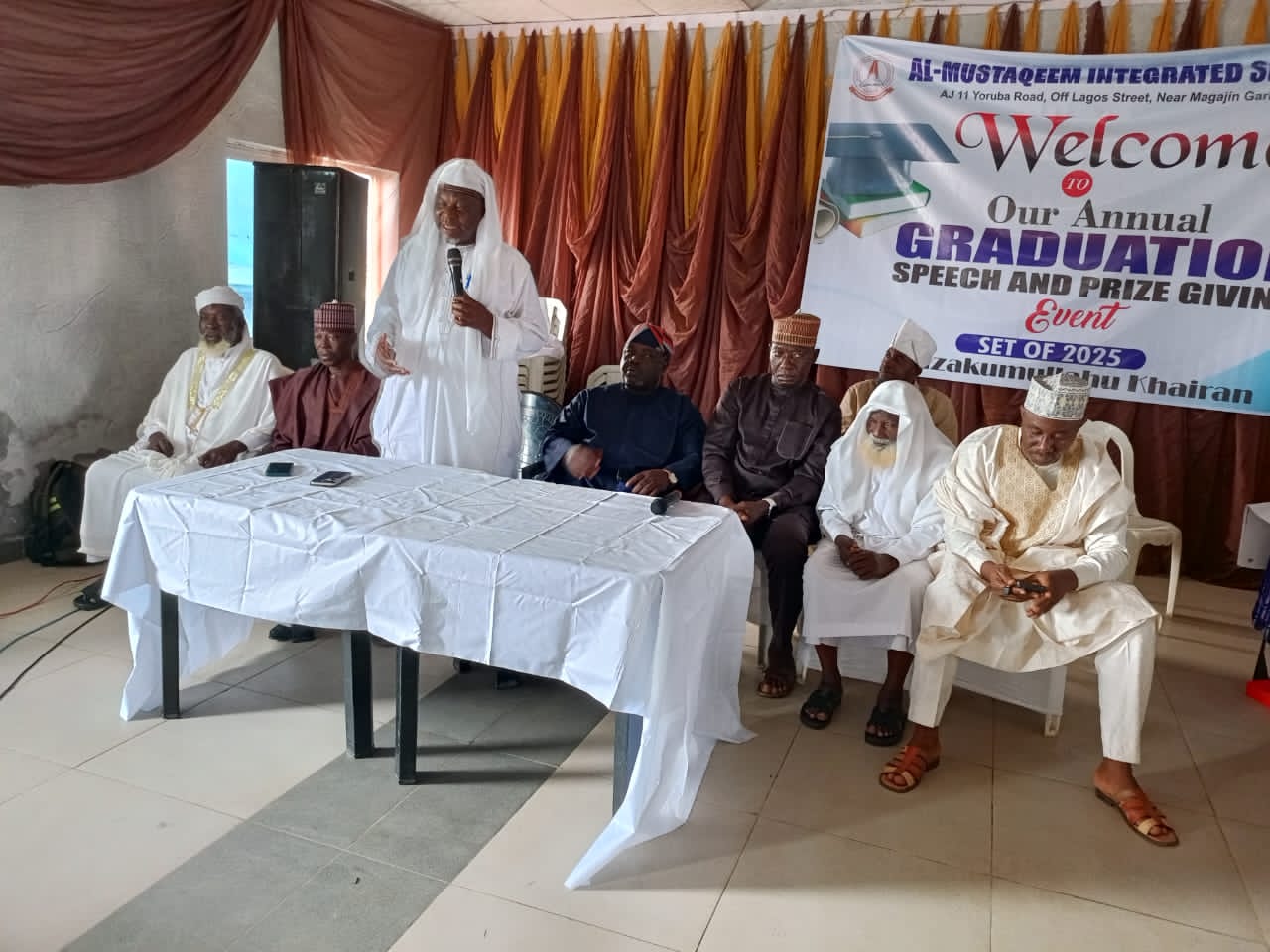
Prof. Mujahid made this assertion while speaking at the graduation, speech, and prize-giving day ceremony of Al-Mustaqeen Integrated Schools, Doka, Kaduna.
He stressed the critical roles of both schools and parents in shaping morally sound and globally competitive individuals.
According to him, the purpose of a school is not to generate profit, but to nurture and empower students for the global stage.
Prof. Mujahid criticized the commercialization of education, which often leaves behind talented children from less privileged backgrounds.
He urged schools to prioritize knowledge and moral training over profit, noting that every child deserves access to quality education, regardless of their financial background.
He likened schools to hospitals, stating that teachers should treat students like patients—listening, diagnosing, and responding with the right approach and not just mechanically delivering lessons.
“We used to have guidance and counseling offices in schools. Now, they are nearly non-existent. These structures are vital because education is not just about teaching; it’s about character transformation,” he said.
In a presentation focused on “The Role of Islamic-Oriented Schools and Parents in Nurturing Global Ambassadors,” the Islamic Scholar addressed the popular misconception surrounding the Islamization of knowledge, emphasizing that Islam recognizes no distinction between religious and secular knowledge.
“what people often refer to as “Western education” merely describes knowledge that either ends with worldly benefit or originated from non-Islamic traditions.
“According to the history of knowledge, Muslims were pioneers in various disciplines even when Europe was still in the Dark Ages,” he said, referencing great Muslim scholars such as Ibn Sina, Ibn Khaldun, Al-Farabi, and Ibn Rushd—all of whom were revered in Europe for their intellectual contributions”
Prof. Mujahid, who is also the Chief Imam of Maiduguri Road Mosque, explained that the Islamization of knowledge involves purging knowledge of corruption, deviation, and immorality.
He emphasized that all knowledge comes from Allah, who taught mankind what it did not know, and thus all branches of knowledge, including science, engineering, and the arts should be accorded due respect.
“We don’t claim those who study science are less Muslim than those who study Islam. It all depends on intention and the contribution to humanity and the progress of the religion,” he stated.
He further emphasized the importance of tailoring teaching methods to individual students’ needs, as children come from diverse backgrounds and may carry emotional and psychological burdens into the classroom.
The education expert enjoined parents that their responsibility does not end with enrolling a child in school, but being role models in character and actively monitoring how their children apply what they learn.
“If we want to produce better children, schools must go beyond knowledge delivery. They must provide supervision, sympathy, and understanding—recognizing that every child is unique,” he added.
In his remarks, the Proprietor of Al-Mustaqeen Integrated Schools, Abdul-hakeem Mustapha, said the institution combines both islamic and western education to provide students with a well-rounded and globally competitive foundation.
He explained that the curriculum is designed to help students maintain their islamic identity while excelling in diverse environments, both locally and internationally.
He also appealed to well-meaning individuals, corporate bodies, and government agencies to support the school by providing solar-powered boreholes to address the water shortage affecting both the school and the host community.
In addition, the school is in dire need of a library and Information and Communication Technology (ICT) laboratories to help students meet the demands of 21st-century education.
A total of nine students graduated from the primary school to the secondary section, while twenty-six advanced from the nursery to the primary level.
The colorful event featured presentations by dignitaries, Qur’anic recitations by pupils, and an exhibition of hand-made products, showcasing the school’s commitment to entrepreneurship and practical learning.
Daniel Karlmax