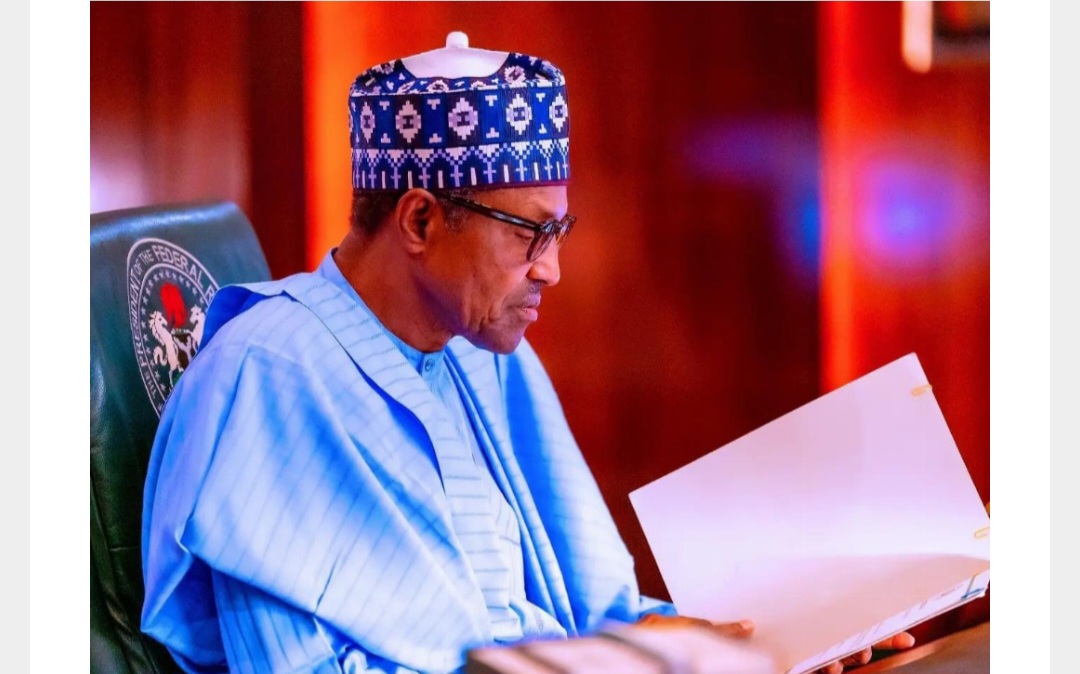
Former President, Muhammadu Buhari stands as a monumental figure in Nigeria’s political history.
He was a leader whose influence spanned both military rule and democratic governance, serving first as Nigeria’s military Head of State from January 1984 to August 1985, and later as a twice-elected civilian President in 2015 and 2019,
General Buhari’s career was marked by an unyielding commitment to discipline, integrity, national security, and public accountability.
Buhari was born into a Muslim family in Daura, Katsina State, North-West Nigeria, in 1942. He attended the Katsina Provincial Secondary School (now Government College, Katsina) from 1956 to 1961. He joined the Nigerian Army in 1961 when he was admitted to the Nigerian Military Training College, Kaduna.
He was Nigeria’s second longest serving leader for 9 years, 7 months and 27 days; He spent 1 year, 7 months and 27 days as military leader (Dec 31, 1983 to Aug 27, 1985) and eight years as democratically elected President (May 29, 2015, to May 29, 2023). He was the first military governor of Borno State in 1976.
Renowned for his Spartan lifestyle and principled approach to governance, former President Buhari made history in 2015 as the first opposition candidate to unseat an incumbent through the ballot box.
His election reflected Nigerians’ deep desire for change, particularly in the fight against corruption, insecurity, and economic mismanagement.
Central to Buhari’s Presidency was a vigrous anti-corruption campaign, by which he he bolstered the operations of the Economic and Financial Crimes Commission (EFCC), launched the Treasury Single Account (TSA) to consolidate government revenues, and championed whistleblower policies that led to the recovery of billions of naira in looted funds.
He also instituted reforms to improve transparency in budgeting and public procurement.
General Buhari’s legacy also rests firmly on a foundation of extensive infrastructural development across the country.
Under his administration, Nigeria regaines control of the 18 local government areas in Borno and 3 in Yobe States, which were hitherto under Boko Haram.
She also witnessed the completion of the Abuja-Kaduna and Lagos-Ibadan railway lines, the Second Niger Bridge, and the reconstruction of key highways, such as the Abuja-Kano and Lagos-Ibadan expressways.
He also commissioned the new terminal buildings at major international airports in Lagos, Abuja, Port Harcourt, and Kano, and ramped up investments in rural electrification and dam projects for energy and irrigation.
In agriculture, he championed the Anchor Borrowers’ Programme, which empowered millions of small-holder farmers, reduced rice importation, and encouraged local food production.
His administration also prioritised digital innovation, creating a pathway for Nigeria’s growing tech ecosystem to thrive through investment in broadband infrastructure and youth empowerment programs.
Though not without challenges, Muhammadu Buhari will be remembered for his dogged pursuit of reform, his passion for restoring national order, and his efforts to modernise Nigeria’s public infrastructure.
Before serving as Head of State, Buhari was appointed by General Murtala Muhammad as the Military Administrator of the Northeastern State from 1975 to 1976.
He was appointed General Olusegun Obasanjo as the Federal Commissioner for Petroleum and Natural Resources from 1976 to 1978.
Major General Buhari was later overthrown by General Ibrahim Babangida, and after General Sani Abacha took over power, he appointed General Buhari as Chairman, Petroleum Trust Fund (PTF) from 1995 to 1999.
Right after inauguration in 2015 as democratically elected President, General took ill that lasted from January to March 2017.
His enduring legacy is that of a leader who strove to build a stronger, more secure, and more self-reliant nation, anchored on the pillars of honesty, sacrifice, and public service.
RN