
By NASIR MALALI; Editing by BASIRAT MEMUDU
The Kukah Centre for Faith, Leadership, and Public Policy has provided recommendations that will assist government and policymakers at the state and federal level to come up with a well-informed legal framework that will guide community security operatives for effective service delivery.
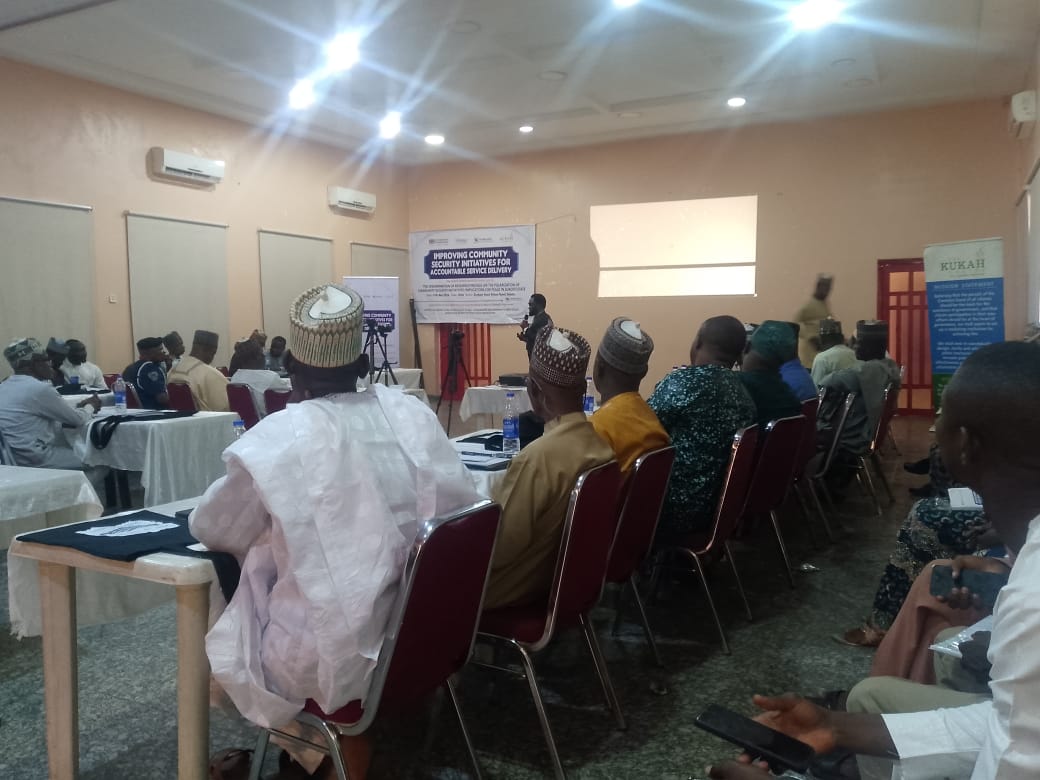
Speaking at a meeting aimed at disseminating the research findings on the polarization of community security initiatives, the Project Manager of the Kukah Centre, Mr. Terseer Bamber, said the recommendations were provided after a research project aimed at strengthening the legal and institutional framework to ensure best practices in community security operations in the country.
Mr. Bamber explained that the research project was supported by the Strengthening Peace and Resilience in Nigeria (SPRiNG) Programme, UK International Development, and Tetra Tech International Development, in collaboration with the Centre for Peace Studies of Usmanu Danfodiyo University, Sokoto.
He said the research project was informed by the increasing reliance on and demands placed on community security outfits, occasioned by decades of insecurity, tribal, and religious conflicts in Nigeria, especially in Sokoto, Kaduna, Katsina, Benue, and Plateau states in the northern part of the country.
Mr. Terseer Bamber expressed concern that such security operatives established by some states lack standard operating procedures and are mostly accused of abuse of power and human rights violations, among others.
In his presentation, the team leader of the project and Coordinator of the Centre for Peace Studies at Usmanu Danfodiyo University, Prof. Usman Abdulkadir, said the research findings, totaling one hundred and forty five pages, identified the genesis that led to the polarization of community security operatives.
Prof. Usman explained that the findings also provided nine pages of recommendations to guide the structure, organization, formation, and operations of the community security initiative.
He was optimistic that if policymakers and the government accepted the recommendations and enacted laws based on them, it would effectively guard against the politicization and polarization of community security operatives, citing the upcoming 2027 general elections in the country.
The event was attended by relevant government agencies, traditional leaders, security agencies, and concerned members of the public.