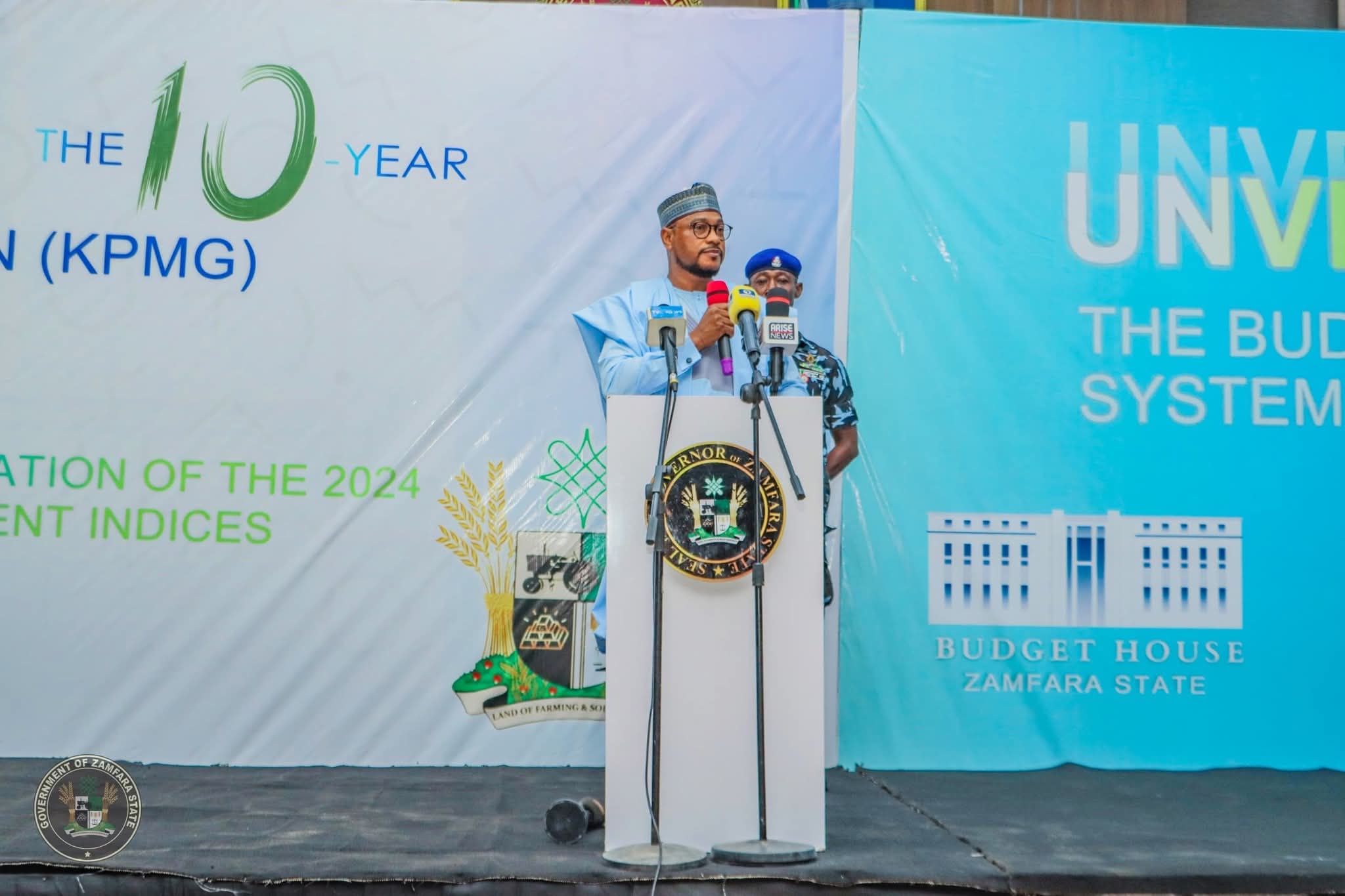
Governor Dauda Lawal has launched the Zamfara State Development Plan 2025–2034, describing it as a bold and strategic roadmap designed to shape a new future for the state.
Speaking at the launch event held in Gusau, the state capital, Governor Lawal said the plan is a long-term, evidence-driven, and globally aligned framework that reflected the aspirations of the people and their collective determination to transform Zamfara into a model of peace, productivity, and shared prosperity.
He explained, that the Development Plan is anchored on six strategic pillars such as Economy, Infrastructural Development, Social Welfare & Development, Human Capital; Governance, Administration & Capacity Development; and Environmental Sustainability.
“On assumption of office in May 2023, we met a state many described as dysfunctional. Yet we resolved from day one that Zamfara would not be defined by its challenges, but by our determination to rebuild, reform, and rebound,” the Governor said.
Governor Lawal emphasized that, the plan is the first comprehensive long-term roadmap in the state’s recent history, built on robust data, extensive stakeholder engagement, and aligned with global and national frameworks such as the Sustainable Development Goals (SDGs), Nigeria’s National Development Plan 2050, and the African Union Agenda 2063.
“It sets clear sectoral priorities, measurable outcomes, and a monitoring and evaluation framework that ensures transparency at every stage of implementation. With this plan, we envision Zamfara becoming a benchmark for transformative economic growth—not only in Nigeria but across Africa,” he stated.
He highlighted the administration’s commitment to leveraging Zamfara’s abundant resources, promoting innovation and technology, and strengthening governance systems to drive inclusive growth and stability.
“Zamfara’s comparative advantage lies in agriculture and natural resources, a strength we are determined to harness fully,” he said.
Governor Dauda Lawal cited partnerships such as the newly signed agreement with the Ministry of Finance Incorporated (MoFI) and support from the African Development Bank to boost mechanized farming, agro-processing, and value-chain development.
The Governor noted that the plan will create jobs, enhance food security, open global markets to Zamfara’s produce, and reduce income inequality, a factors he believes will significantly address insecurity driven by poverty.
He added that supporting small and medium enterprises through programmes like SABER, NG-CARES, and other interventions will dismantle barriers to private enterprise, empower entrepreneurs, stimulate grassroots businesses, and promote sustainable peace across communities.
Governor Lawal also reaffirmed his administration’s commitment to a transparent and responsible approach to developing the solid minerals sector.
“By the special grace of Almighty Allah, Zamfara State will no longer be defined by illegal mining and environmental degradation. This plan provides for comprehensive geodata mapping, community participation, environmental protection, and investment in mineral value addition, ensuring our mineral wealth uplifts our people,” he said.
The Governor stressed that achieving the vision outlined in the plan requires collective effort.
“Government alone cannot achieve this. We need the support of traditional institutions, communities, youth, women, farmers, entrepreneurs, civil servants, investors, and the diaspora. We all share in this mission,” he noted.
He called on national and international partners to believe in Zamfara, invest in its future, and collaborate with the state government, emphasizing that “our doors are open.
The event was attended by top government officials and other Stakeholders.
COV/AMINU DALHATU