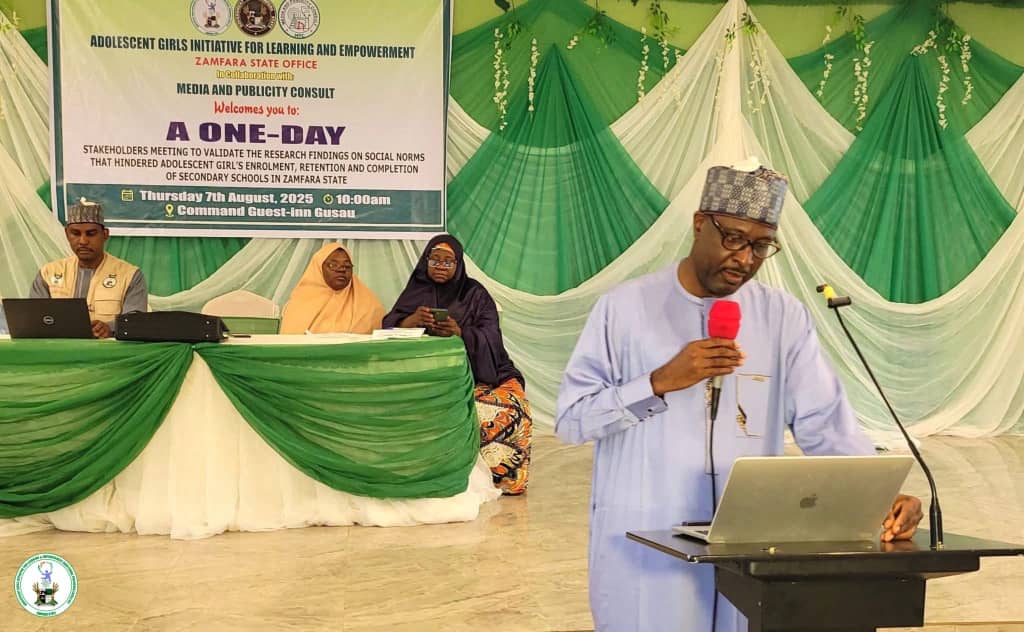

Participants at a one day stakeholders’ meeting to validate research findings on social norms affecting girls’ education in Zamfara State have urged parents, community leaders, and government at all levels to address the barriers preventing adolescent girls from completing secondary school.
AGILE in Zamfara State in Collaboration with Media and Publicity Consult organized a One Day Stakeholders Meeting to Validate the Research findings on Social Norms that hinder Adolescent Girls Enrollment, Retention and Completion of Secondary Schools in Zamfara State.
Speaking at the meeting, Professor Abubakar Aliyu Liman of Ahmadu Bello University, Zaria, emphasized the need for stakeholders to create an enabling environment that will encourage girls to remain in school.
Professor Liman, who is also the Lead Consultant for the AGILE research project in Zamfara, identified forced marriage, gender stereotypes, and lack of parental support as some of the major challenges affecting girls’ education in the state.
He said such issues could be addressed through sustained community engagement and a change in societal attitudes.


Representatives from the Zamfara State Ministries of Women Affairs and Education commended the impact of the AGILE project in Zamfara and called for further improvements, including the provision of better Water, Sanitation and Hygiene (WASH) facilities in schools.
Other participants commended AGILE in Zamfara State for it ongoing effort to ensuring adolescent girls remain, completed secondary education and beyond.


Deputy Coordinator of AGILE Project in Zamfara State, Dr. Salisu Dalhatu, disclosed that 317 out of the 440 schools earmarked for renovation under AGILE had been completed, while over 8,000 girls were benefiting from the conditional cash transfer initiative.
Managing Director of Media and Publicity Consult (MPC), Mr. Nasiru Usman Biyabiki, said the validation session was aimed at refining the findings for more effective interventions.
According to him, awareness campaigns had contributed to Zamfara ranking among the top five performing states in AGILE implementation nationwide.
The meeting, convened by MPC, also reviewed findings presented by the organisation’s Director of ICT, Hibban Buhari, which identified poverty, cultural beliefs, forced marriage, and poor school infrastructure as major obstacles to girls’ enrolment and retention.
The study recommended the use of Hausa, Fulfulde, and Arabic languages in enlightenment campaigns, with radio as the primary medium due to its wide reach.
AMINU DALHATU