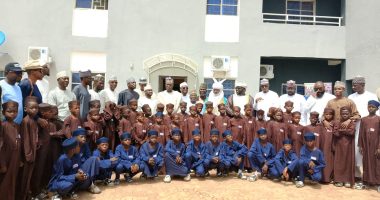
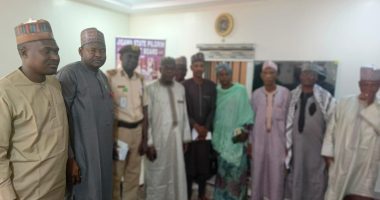
Governor Umar Namadi has restated his administration’s commitment to modernizing Qur’anic education in Jigawa State to align with contemporary educational standards.
He made this known on Thursday during the closing ceremony of the 40th Jigawa State Qur’anic Recitation Competition held at Sir Ahmadu Bello Hall in Dutse.
The governor described the presence of young Qur’anic students as a blessing to the state, emphasizing the importance of Qur’anic knowledge in shaping morals and easing life’s challenges.
Umar Namadi said the competition has demonstrated the high level of competence among participants, noting the narrow margins between winners and runners-up.
He pledged that his administration would continue to strengthen Qur’anic education through the Tsangaya Education Board, which integrates Qur’anic studies into the state’s formal school system with a dedicated budget.
The governor announced that outstanding students will now be sponsored to pursue further studies, either in Qur’anic education or in secular fields such as engineering and medicine.
According to him, the state government will ensure that Qur’anic education receives a full budgetary allocation, as it sees a bright future in its advancement.

He added that Jigawa had previously hosted an international Qur’anic recitation contest introduced to Nigeria by the Imam of Madinah, and disclosed that the state has secured approval to host the 2026 National Qur’anic Recitation Competition.
Governor Namadi praised the State Bureau of Islamic Education, the Tsangaya Education Board, and the Ministry of Higher Education for their roles in advancing Qur’anic studies.
The governor further expressed gratitude to Allah for blessing Jigawa with talented young Qur’anic students who continue to uphold the teachings of the Holy Book.
He said the state will continue to support and sponsor initiatives that promote Islamic and Qur’anic education across generations.
The 2025 edition of the Qur’anic competition featured male and female contestants across categories covering two, ten, thirty, and sixty parts of the Holy Qur’an.
Usman MZ