
Minister of State for Works, Bello Muhammad Goronyo, has expressed concern over the slow pace of work on a section of the Zaria–Funtua–Gusau–Talata Mafara–Sokoto dual carriageway, described the road as a critical national corridor that must be delivered urgently to save lives and boost economic activities.
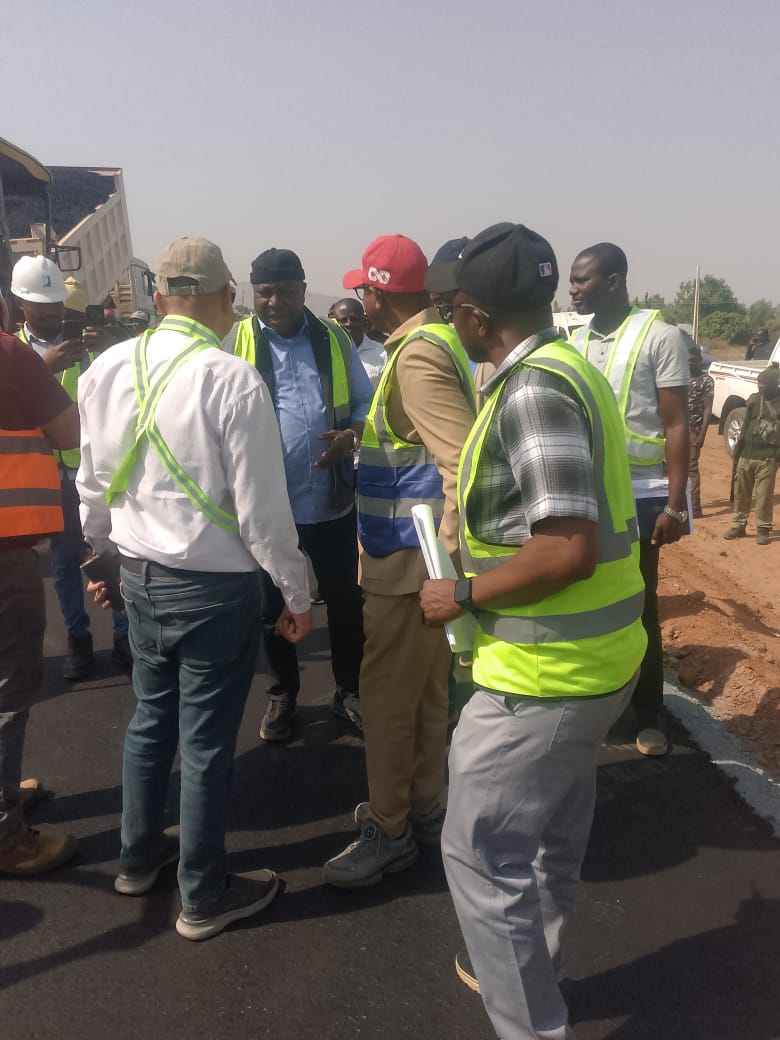
The Minister stated this during an inspection tour of the ongoing project, conducted on the directive of President Bola Ahmed Tinubu and the Minister of Works, Senator David Umahi.
Speaking to journalists at Kilometre 16 along the Gusau axis, near Bungudu, Goronyo said the inspection was aimed at assessing the level of work done so far by contractors handling different sections of the road.
He disclosed that, the Sokoto–Talata Mafara section, being handled by CBC Construction Company and spanning about 105 kilometres, has recorded about 27 percent completion, described the quality of work as impressive.
According to him, some sections of the road were initially skipped due to non-payment of compensation to affected communities, a challenge he said has now been resolved.
Bello Goronyo pointed out that, the Governor of Sokoto State, Dr. Ahmad Aliyu Sokoto, has paid the outstanding compensation, and commend him highly for supporting the Federal Government and Mr. President.
He said they have directed CBC to return to those skipped sections and complete them to ensure a smooth and continuous road.
However, the Minister expressed dissatisfaction with the pace of work by Triacta Nigeria Limited, the contractor handling another section of the project, which he said has recorded only 16 percent completion despite being awarded the contract around the same period in May 2023.
“This corridor is extremely important. Nigerians are suffering. Accidents are frequent, and travel time from Sokoto to Gusau, which should be about one and a half hours, now takes four to five hours. This is unacceptable,” Goronyo said.
As a corrective measure, he announced that Triacta has been restricted to work between Kilometre 0 and Kilometre 37 in Gusau, with a clear directive to complete both carriageways before November.
He added that the remaining sections, covering Kilometres 37 to 105, may be reassigned to another reputable contractor capable of delivering the project within a shorter time frame.
While faulting the speed of work, the Minister clarified that, the quality of construction by Triacta remained satisfactory, noting that, the company has the required equipment and technical capacity.
Goronyo also directed all contractors working along the corridor to maintain the existing road, fill potholes, and ensure motorists can travel safely while construction continues.
“It is unacceptable for motorists to suffer damage to their vehicles because of unattended potholes. Contractors must maintain the existing route while working on the new carriageway,” he stressed.
On security, the Minister commended the Office of the National Security Adviser (ONSA), led by Mallam Nuhu Ribadu, as well as state governors along the corridor, for providing adequate protection to contractors on site.
He assured that any contractor facing security challenges could promptly seek support from the state governments or the NSA’s office.
The Minister disclosed that the overall completion timeline for the project is 2028, ireiterated the Federal government commitment to constructing long-lasting road infrastructure through the use of reinforced concrete technology, citing the frequent failure of asphalt roads due to heavy vehicular traffic.
Bello Mohammed Goronyo explained that many roads across the country have remained unconstructed or poorly maintained for decades, with some lasting over 50 to 100 years without durable intervention.
According to him, successive governments have often rebuilt the same roads every 10 years or less because asphalt pavements typically deteriorate within a short period, especially under pressure from heavy-duty vehicles.
“The base of asphalt roads hardly lasts beyond 10 years. That is why you see that even when a road is completed, after a few years, government has to return to reconstruct it again,” he said.
He noted that the damage to major highways is largely caused by heavy axle loads from articulated vehicles, including trucks and deepers transporting large volumes of goods across the country.
To address this challenge, President Bola Ahmed Tinubu has prioritised infrastructure development and directed that critical highways be constructed using continuous reinforced concrete technology.
The official explained that concrete roads are far more durable, capable of lasting over 50 years and beyond, even under constant pressure from heavy vehicles.
“With concrete roads, these heavy axle vehicles will no longer destroy our highways. Once fixed, the roads will serve Nigerians for many decades,” he added.
He cited the newly constructed road corridor from Sokoto to Talata Mafara as a practical example, noting that, the road is significantly thicker, smoother and offers a better travel experience for motorists.
“The President is passionate about this project, and we are determined to ensure it is delivered to standard and within record time,” he said.
The Minister was accompanied by some Directors of the Ministry and the Comptroller, Ministry of Works in Zamfara State.
AMINU DALHATU