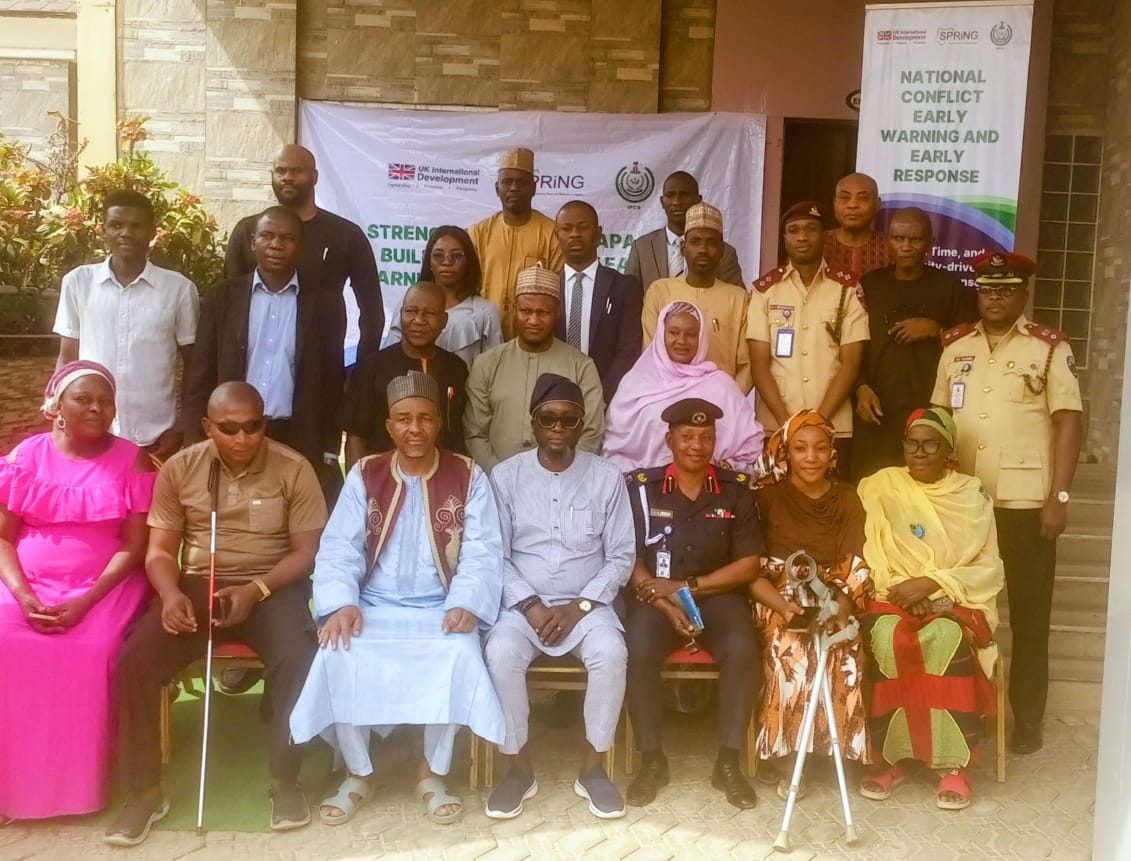

Stakeholders drawn from security agencies, civil society organisations, community groups and government institutions have converged in Kaduna for a capacity-building workshop aimed at strengthening Nigeria’s early warning and early response mechanisms for conflict prevention.
The workshop was organised by the Strengthening Peace and Resilience in Nigeria, SPRING programme in collaboration with the Institute for Peace and Conflict Resolution (IPCR), a federal government agency, with support from the UK’s Foreign, Commonwealth and Development Office held in Kaduna
Speaking at the opening of the workshop, Lead facilitator of the program, Mr. Steve Agbo, said the initiative was designed to enhance the effectiveness of the multi-stakeholder early warning response group in Kaduna State.
He explained that the group is made up of conventional and non-conventional security actors, including the military, paramilitary agencies, civil authorities, civil society organisations, religious bodies and community-based groups.
According to Agbo, Nigeria’s evolving conflict landscape is driven mainly by climate change, competition over land, water resources, and socio-economic pressures which all requires a more coordinated and informed response system.
He noted that while early warning reports often exist, delayed or inappropriate responses have remained a major challenge. “This programme seeks to create a paradigm shift from the traditional early warning system to an integrated model with standby response teams, so that reported threats can be addressed promptly, either through kinetic or non-kinetic means,”
Mr. Agbo added that strengthening the capacity of community-level actors such as vigilantes, hunters, transport workers and other grassroots groups would help prevent avoidable violence, criminality and loss of lives.
He stressed that prolonged conflicts often degenerate into wider criminal activities such as kidnapping and banditry, which could be curtailed through timely intervention.
Also speaking, a participant and woman mediator with the Women Mediators Network, Hajiya Aisha Wada Inusa, said the training would enable participants to better identify early signs of conflict and take preventive action.
She explained that unusual gatherings or changes in community behaviour often serve as warning signals, which can be addressed through engagement with traditional rulers, religious leaders, women groups and the media before violence erupts.
On his part, Mr. Chidozie Douglas Acholonu, a facilitator with the SPRING programme, said the project is working closely with IPCR to revitalise its conflict early warning and response centre.
He explained that the initiative leverages mobile technology and digital platforms to ensure that information received via text messages, WhatsApp or phone calls is transmitted to IPCR’s situation room and relayed to relevant security agencies, including the DSS, police and Civil Defence.
Mr. Acholonu emphasised that beyond technology, the programme promotes collaboration and trust among civil society actors, government officials and security agencies. “Human interaction and dialogue remain critical. When stakeholders understand each other’s roles and capacities, synergy improves and responses become more effective,” he said.
The SPRING–IPCR programme, which has also held national-level engagements with security agencies in Abuja, aims to deepen coordination from the federal level down to the states as part of broader efforts to strengthen peace and resilience across Nigeria.
Cov/Shindong Bala