
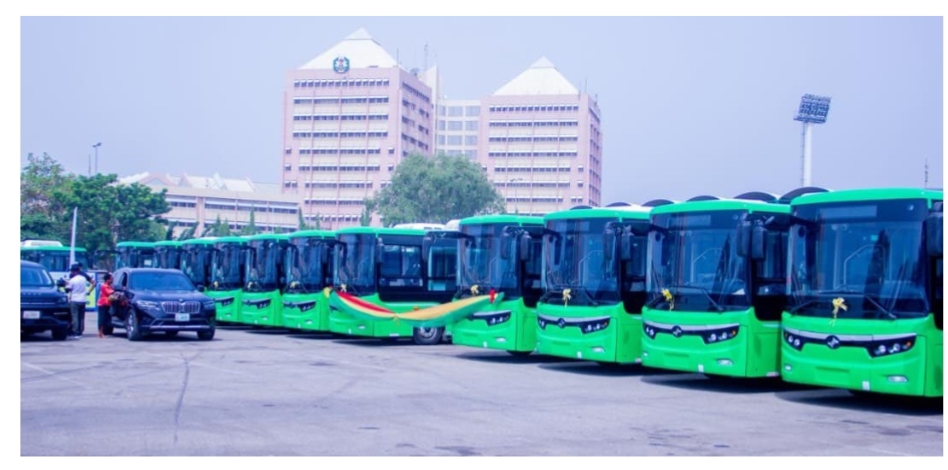

Federal Government says it will continue to support projects that advance Nigeria’s clean energy transition, especially those that deliver affordable mobility for citizens.
The Minister of State for Petroleum (Gas), Ekperikpe Ekpo, stated this during the inauguration of 40 electric-powered buses by the Presidential Initiative on Compressed Natural Gas (PiCNG) in Abuja.
The Minister, represented by his aide, Abel Igheghe, described the rollout as “another bold step in Nigeria’s journey towards cleaner, smarter and more sustainable mobility.”
Ekpo said the initiative reflects the government’s commitment to cleaner fuels, including compressed natural gas (CNG), liquefied petroleum gas (LPG), liquefied natural gas (LNG), and electric mobility as part of broader efforts to reduce emissions and modernise the nation’s transport system.
“This gathering is not just a product showcase; it is a statement of intent. We will continue to support initiatives that align with our clean energy aspirations. Electric vehicles are an important part of the future, and they will create new industries, new jobs and new opportunities for Nigerian innovators,” he said.
The Minister added that the Ministry of Petroleum Resources would sustain policies that promote alternative fuels, deepen gas utilisation, and encourage technology transfer.
The Executive Chairman of PiCNG, Ismael Ahmed, said the introduction of the electric buses aligns with the initiative’s mission to deliver affordable and reliable transportation to Nigerians.
“This is clean energy. This is affordable energy. This is available energy. What matters is the ordinary Nigerian, the person in Kano, Zanya or Daura whose transportation costs must come down,” he said.
Ahmed noted that PiCNG plans to power charging stations using CNG to reduce reliance on grid electricity.
“We have sunlight, we have gas, and we will use them to deliver cheaper and cleaner mobility,” he said.
He added that the 40 electric buses will be deployed immediately across several states to ease transportation, especially during the festive season.
PiCNG also reaffirmed its partnership with private investors to expand charging infrastructure nationwide, with additional stations planned along major transport corridors.
At a separate press briefing, Ahmed announced the launch of Pi-CNG 2.0, the next phase of Nigeria’s clean mobility transition. He explained that although the initiative was initially introduced to cushion the impact of fuel subsidy removal, it has evolved into a catalyst for national energy transformation.
He highlighted key achievements recorded over 20 months, including activation of CNG value chains in 28 states, establishment of more than 58 refuelling stations, deployment of thousands of NGV buses and tricycles, onboarding of over 300 automotive conversion partners, and training of more than 6,000 Nigerians — including members of the armed forces and women in Kano. He added that the initiative has also secured more than $2 billion in investment commitments.
Other milestones include progress toward local manufacturing of CNG equipment at the Ajaokuta Industrial Park, expansion of gas-supply infrastructure along the northern corridor, partnership with NDDC for more CNG stations in the Niger Delta, and activation of a national electric-mobility programme.
RN