By Shindong Bala
A climate advocacy group, Bridge That Gap Initiative, has expressed concern over the exclusion of Kaduna State from Nigeria’s Great Green Wall programme, despite growing threats of desertification, land degradation and declining soil fertility in parts of the state.
The Executive Director of the organisation, Gloria Kasang Bulus, raised the concern at a quarterly Media Roundtable in Kaduna, where she urged journalists to investigate the extent to which global environmental commitments are being translated into concrete action at the community level.
Gloria Bulus explained that Nigeria’s Great Green Wall initiative covers an estimated 1,500 kilometre stretch across 11 frontline states of Zamfara, Katsina, Jigawa, Kano, Sokoto, Borno, Yobe, Bauchi, Gombe, Adamawa and Kebbi with plans to establish a 15 kilometre wide belt of drought-resistant trees.
She, however, noted that Kaduna, despite facing similar environmental pressures, is not among the designated frontline states.
“Nigeria is part of the Great Green Wall initiative, but Kaduna is outside the 11 designated frontline states. This raises important questions: Why is Kaduna excluded despite facing similar environmental pressures?”
The climate advocate said the organisation estimates that between 10 and 15 per cent of Kaduna’s land is threatened by desertification as a result of human activities and natural factors.
She said declining soil fertility and land degradation were already affecting communities in parts of northern Kaduna, warning that the consequences could worsen if restoration efforts were not adequately funded and supported.
Bulus also challenged the media to investigate the level of government support available to communities affected by desertification and land degradation, as well as whether local environmental restoration initiatives are receiving adequate funding.
She said the concerns were particularly important in the wake of the 17th Session of the Conference of the Parties (COP17) of the United Nations Convention to Combat Desertification (UNCCD), held in Ulaanbaatar, Mongolia, from August 17 to 28, 2026.
According to her, at least 15 of the 23 targets contained in the relevant framework have direct implications for Kaduna State.
She listed the targets to include restoration of degraded ecosystems, protection of forests and wildlife habitats, sustainable agriculture and forestry, pollution reduction, protection of ecosystem services such as water, soil and pollination, development of urban green spaces, women’s land rights and participation, as well as indigenous and community participation in environmental decision-making.
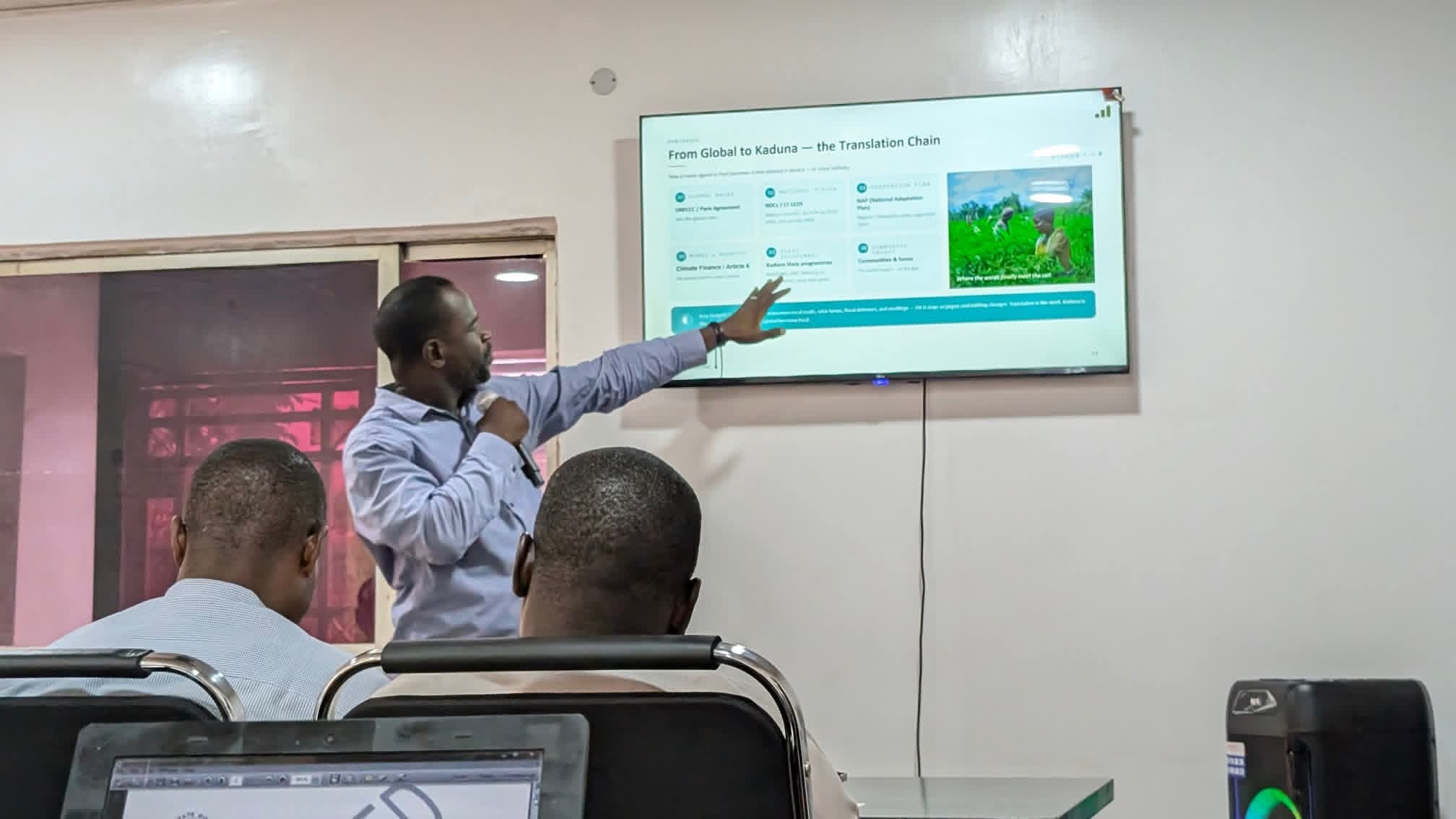
In a presentation, Mr. Zinta Akpoko mentioned that environmental degradation was already producing ripple effects on livelihoods, agricultural productivity and food prices.
He noted that soil degradation, insecurity and inconsistent rainfall patterns were combining to place additional pressure on farmers and communities.
Mr. Zinta stressed that while recent declarations by governors and local leaders on land management represented a significant achievement, gaps remained between policy commitments and implementation.
He therefore called on journalists to focus not only on international environmental declarations but also on what he described as the “wins and gaps” in translating such commitments into funding, programmes and measurable improvements in affected communities.
Mr. Zinta Akpoko urged the media to use its watchdog role to connect global climate and environmental commitments with local realities and hold governments and other decision-makers accountable for results.
Editing By Godwin Duru