
Written By Daniel Karlmax; Edited By Godwin Duru
As the world marks World Environment Day, the conversation about environmental protection extends beyond annual celebrations and public awareness campaigns.
It is a moment to reflect on a fundamental reality: humanity’s survival is inseparable from the health of the natural systems that sustain life on earth.
The relationship between people and nature is not one of convenience but of dependence.
Every breath of air, drop of water, harvest from the soil, and source of food originates from environmental processes that often operate beyond national boundaries and human visibility.
As civil rights leader Martin Luther King Jr. once observed, “All life is interrelated. We are all caught in an inescapable network of mutuality, tied into a single garment of destiny.”
Today, that interconnectedness is more evident than ever.
Nature functions as a vast, interconnected system in which ecosystems support one another across continents and oceans.
One striking example is the Sahara Desert, whose mineral-rich dust travels thousands of kilometers across the Atlantic Ocean, replenishing nutrients in the Amazon rainforest and supporting ecological productivity in South America.
Similarly, the Congo Basin Forest—one of the world’s largest tropical forest systems—plays a critical role in regulating atmospheric conditions, storing carbon, and maintaining biodiversity that benefits not only Africa but the entire planet.
Migratory species such as the Arctic tern further demonstrate nature’s interconnected design.
Traveling extraordinary distances between polar regions, these birds contribute to ecological balance across multiple continents and marine environments.
These natural processes serve as reminders that environmental health cannot be viewed through local or national lenses alone.
The ecosystems that sustain life transcend political borders and geographic divisions.
The Environment is the Humanity’s Life-Support System.
The atmosphere protects life from harmful ultraviolet radiation.
Forests regulate climate patterns and influence rainfall.
Wetlands and soils filter water and support agricultural productivity.
Worthy of note also, plants absorb carbon dioxide and release oxygen, while animals contribute to ecosystem stability and food security.
Nature also remains one of humanity’s greatest pharmacies, providing compounds and biological resources that have led to life-saving medicines and medical breakthroughs.
Despite their immense value, these ecological services are often overlooked because they operate quietly in the background of daily life.
Yet without them, modern civilization would be impossible.
Environmental protection, therefore, is not merely an obligation to future generations.
It is an immediate necessity for present-day survival and prosperity.
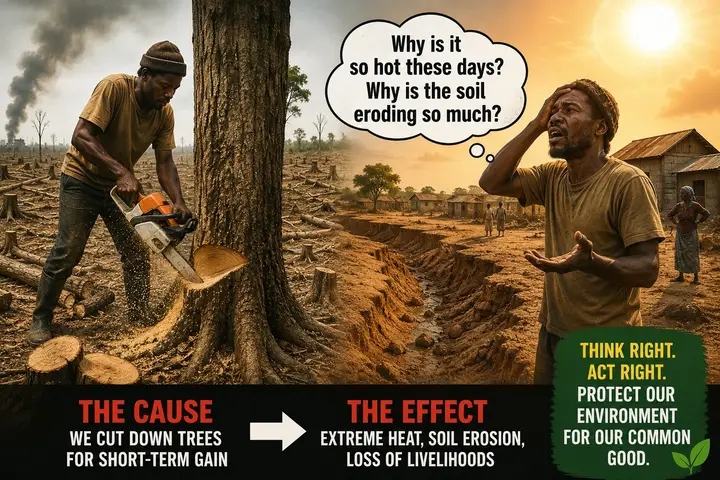
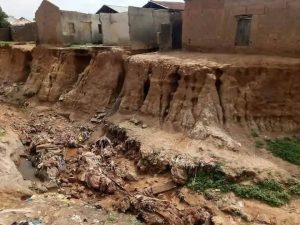
Across the globe, environmental degradation continues at an alarming pace.
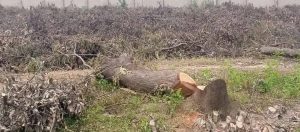
Deforestation, biodiversity loss, land degradation, pollution, and climate change are weakening the ecosystems that support human well-being.
As natural habitats disappear, species populations decline, ecosystem resilience diminishes, and communities become increasingly vulnerable to environmental shocks.
To this end, scientists warn that continued destruction of natural systems could undermine food security, water availability, climate stability, and economic development worldwide.
The challenge is no longer whether environmental decline will affect humanity, but how severely and how quickly.

According to environmental advocate in Nigeria and Founder of Green Climate Africa Yusuf Amoke, Kaduna State recorded the loss of more than 5.3 thousand hectares of natural forest in 2024, largely driven by fuelwood harvesting and charcoal production.
Amoke notes that beyond the visible disappearance of trees lies a much deeper ecological crisis.
Forest ecosystems provide habitats for countless species, including birds, bees, butterflies, mammals, reptiles, insects, plants, and microorganisms that depend on these environments for survival.
He warns that continued habitat destruction threatens local biodiversity and could push endemic species—those found nowhere else in the world—toward permanent extinction.
According to Amoke, forest loss also weakens critical ecosystem services such as carbon storage, watershed protection, soil enrichment, climate regulation, and livelihood support for local communities.
“The loss is not simply a collection of trees,” he argues, “but the destruction of an entire living system that supports both people and nature.”
Every forest cleared without restoration, every polluted river, and every degraded ecosystem reduces the environmental assets upon which future generations will depend.
The consequences extend far beyond wildlife conservation.
Environmental decline directly affects agriculture, public health, economic productivity, and social stability.
The decisions made today regarding land use, energy consumption, conservation, and resource management will shape the quality of life available to future generations.
Protecting nature is therefore not a competing priority to development; it is a prerequisite for sustainable development.
World Environment Day serves as a reminder that environmental stewardship is a collective responsibility.
Governments, businesses, communities, and individuals all have roles to play in protecting forests, conserving biodiversity, reducing pollution, promoting sustainable energy alternatives, and supporting responsible resource management.
The challenge requires more than awareness.
It demands action.
As actor and environmental advocate Harrison Ford famously stated, “Nature doesn’t need people. People need nature.”
The statement captures a simple but profound truth.
The Earth has survived dramatic changes throughout its history and would continue without humanity.
Human civilization, however, cannot survive without healthy ecosystems.
As the world confronts growing environmental challenges, the path forward must be guided by a recognition of humanity’s dependence on nature.
Protecting forests that clean the air, rivers that sustain communities, soils that produce food, and biodiversity that maintains ecological balance is not merely an environmental objective—it is an investment in human survival.
On this World Environment Day, the message is clear: safeguarding nature means safeguarding our future.
The environment may not need humanity to survive, but humanity unquestionably needs the environment.
The time to act is now.