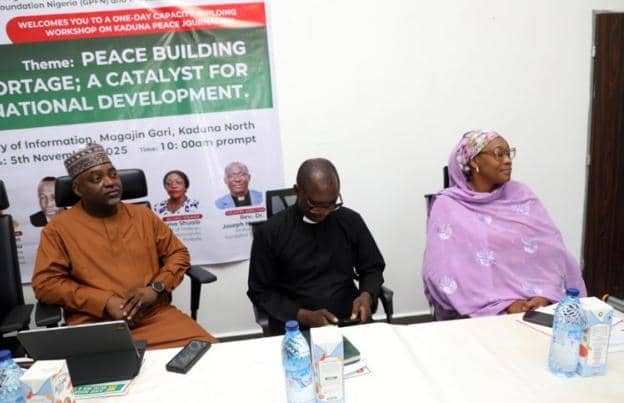

The Kaduna State Commissioner for Information, Malam Ahmed Maiyaki, has clarified that the State Government never paid cash to bandits but instead offered them access to education, healthcare, and livelihood opportunities as part of efforts to end years of killings and kidnappings across the state.
Maiyaki made this known during a one-day workshop on Peace Journalism, organized by the Correspondents’ Chapel of the Nigeria Union of Journalists (NUJ), Kaduna State Council, in collaboration with the Global Peace Foundation Nigeria and the Kaduna State Ministry of Information.
He explained that the initiative, tagged Kaduna Peace Model, represents a deliberate shift from confrontation to conversation — focusing on restoring humanity through dialogue and development rather than financial appeasement. He said peace cannot be achieved through force but must be built on trust.
According to the Commissioner, the turning point came when leaders of armed groups asked the government to reopen markets, schools, and healthcare centres previously shut down due to insecurity. He said the government agreed because these are basic human needs, not ransom payments. “We didn’t give them a dime. What we gave was life back to communities long abandoned,” he explained.
Maiyaki noted that between 2015 and 2023, Kaduna recorded 1,160 security incidents, resulting in 4,876 deaths and thousands of kidnappings and displacements. In 2021 alone, 1,192 people were killed and 3,348 abducted, leading to the closure of 142 schools and 192 health facilities.
He said Kaduna, once declared a “red zone” by the international community, is gradually regaining its image through a non-kinetic approach anchored on intelligence sharing, dialogue, and socio-economic inclusion in partnership with the Office of the National Security Adviser (ONSA).
Through the joint ONSA–Kaduna Peace Committee, he added, more than 500 captives were safely released through negotiations without ransom or the use of force. He said trust is gradually replacing fear, while cooperation is replacing hostility.
Maiyaki cited examples of former bandit leaders such as Jan Bros and Yellow One Million, who now serve as community peace mediators helping to maintain stability in previously volatile areas. He explained that the peace model works because it is owned by the people, with communities co-creating peace instead of having it dictated by government.
He disclosed that over 500,000 hectares of farmland have been recovered, with agricultural and commercial activities revived in Giwa, Birnin Gwari, and Kauru Local Government Areas. Markets have reopened, and between 20 and 30 cattle trucks now move weekly on roads once feared by travellers.
Maiyaki maintained that every reopened school, clinic, or market represents a victory over fear, proving that inclusion and dialogue can achieve what brute force cannot. He said people wanted dignity, not pity, and once they saw sincerity, they embraced peace.
He clarified that the peace process is not a one-off truce but an ongoing engagement involving district heads, clerics, and local leaders to prevent a relapse into violence. According to him, Governor Uba Sani has emphasized that the state is not declaring victory but commitment.
Maiyaki concluded that the Kaduna Peace Model has become a living, evolving process rooted in trust and shared ownership. He stressed that peace is cheaper, deeper, and more enduring when people have a stake in it, adding that the Kaduna experience proves that security without humanity is insecurity in disguise.
By Adamu Yusuf