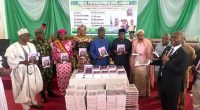
The Senate has demanded up-to-date details on the financial implementation of the 2024 and 2025 budgets.
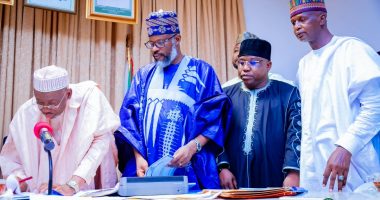
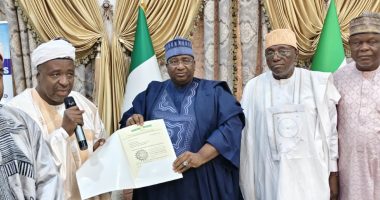
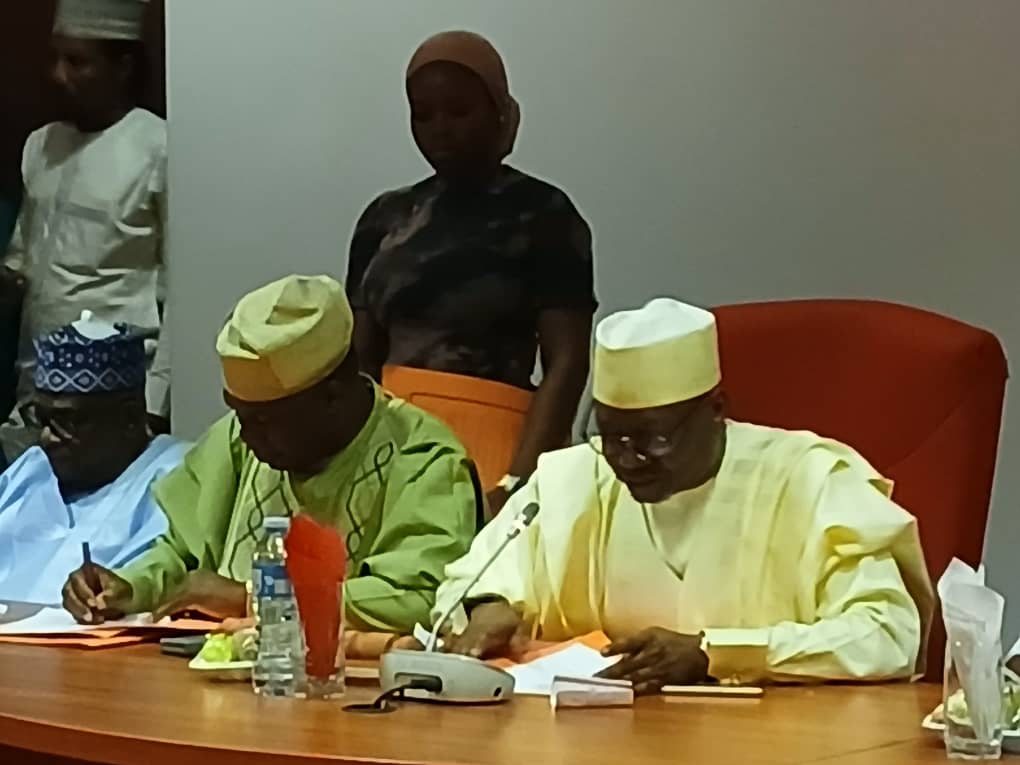
Chairman of the Senate Committee on Finance, Senator Muhammad Sani Musa, gave the directive during an interactive session with the Minister of Finance, the Office of the Accountant-General of the Federation, and the Federal Inland Revenue Service (FIRS).
He stated that the fiscal challenges facing the country require honest dialogue, coordinated responses, and above all, renewed discipline in public financial management.
Senator Sani Musa explained that over the years, the National Assembly has made commendable progress in strengthening the budget framework. However, the recent realities of declining revenues and rising debt servicing have made oil receipts unpredictable, demanding a fundamental rethink of how the nation allocates resources and how transparently it communicates its fiscal position, so that everyone can clearly understand where the country stands.
He added that the focus has now shifted from envelope-based budgeting to a performance- and priority-driven system, where every naira is linked to a measurable outcome.
Senator Musa further emphasized that fiscal sustainability is no longer a slogan, but the guiding principle of Nigeria’s financial management.
He stressed the need to address revenue leakages, improve expenditure efficiency, and strengthen coordination between the Ministry of Finance and the Budget Office.
According to him, greater transparency and accountability will restore public confidence and ensure that budgetary allocations translate in to tangible development impact
The Chairman further reaffirmed the commitment of the committee to supporting the ongoing fiscal reforms to work in collaboration with the ministry and the budget office and to ensure that what happened in 2024 and 2025 will not happened in 2026
Senator sani Musa further reassured that the objective of their meeting is for the ministers of Finance, budget and National Planning to give the actual implementation level of the 2024 and 2025 budgets before talking of Medium Term Expenditure Frame work and strategy paper MTEF of 2026 before talking of its budget.
Similarly, the Chairman after hours of closed session with the Minister said the committee resolved that presentation of Medium Term Expenditure Framework ( MTEF) and Fiscal Strategy Paper ( FSP ) for 2026 to 2029 fiscal years , can only follow after submission of the requested reports to it by the economy managers on the 23rd of this month .
He said they have had the position at which the 2024 budget is, and what the position also of the 2025 budget. And the expectations we are having for the ministry to, as a matter of urgency, bring the MTEF for 2026 to 2029. And the minister has briefed us, and we have collectively agreed that we are making progress, but we need to make more progress.
He added that they have all agreed that we will want documented evidence of the performance of 2024, and our expectations for the 2025 budget, before we start talking about the MTEF for 2026 and the Minister of Finance has agreed to oblige to give them that progress report and agreed to reconvene on the 23rd of October for more discussion
Going by these agreement however there are strong indications that the 2026 budget may likely to be delayed by President Bola Ahmad Tinubu
Earlier before the Committee went into closed door session with the economy managers , while the Minister of Finance and Coordinating Minister of the economy, Wale Edun said high performance is being recorded in the implementation of the capital component of 2024 budget and good performance for 2025 .
However, according to the DG budget office, Tanimu Yakubu , during the two fiscal years ( 2024 &2025), budgetary implementation were somewhat turbulent as some of the underlying assumptions were not met.
He said under the years, most of the assumptions underpinning the 2024 and 2025 budgets turned out differently from projections, saying Oil revenue, assumed at $75 per barrel, fell short by between $10 and $15 due to global price fluctuations.
Also said Inflation also rose beyond projections, affecting borrowing costs and debt service performance, which significantly exceeded targets.
Furthermore, the unforeseen fiscal implications of the Petroleum Industry Act (PIA) 2022 have compounded our challenges.
” Under the Act, 30% of gross oil revenue and 30% of oil and gas profits are retained for upstream operations, while the Federal Government also bears the NNPC’s operating costs. This has reduced the Federation Account allocation by nearly 70% of what used to accrue.
He added that crude oil output has been lower than projected in the MTEF approved by the National Assembly.
Cov/Bashir M