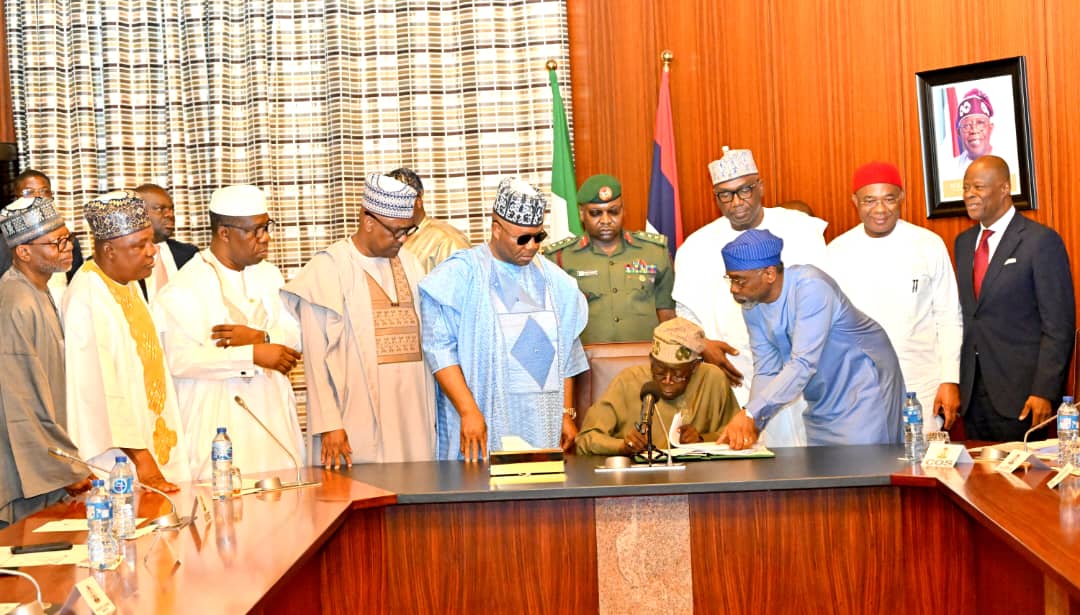

President Bola Ahmed Tinubu has signed into law four landmark tax reform bills aimed at overhauling Nigeria’s fiscal and revenue framework.
The signing ceremony took place on Thursday at the Presidential Villa, Abuja, marking a significant milestone in the country’s efforts to improve tax administration, boost revenue generation, and enhance the ease of doing business.
The newly enacted laws include the Nigeria Tax (Ease of Doing Business) Bill, the Nigeria Tax Administration Bill, the Nigeria Revenue Service (Establishment) Bill, and the Joint Revenue Board (Establishment) Bill.
The bills were previously passed by the National Assembly after extensive consultations with stakeholders from both the public and private sectors.
Speaking during the signing ceremony, President Tinubu described the laws as “a bold step towards building a more efficient, transparent, and business-friendly tax system in Nigeria.”
”He expressed confidence that the reforms would attract increased domestic and foreign investment, support economic growth, and strengthen public finance management.
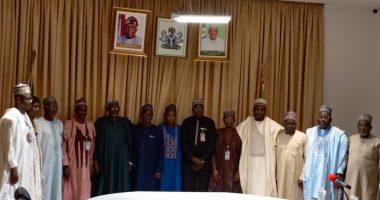
The signing was witnessed by top government officials, including the President of the Senate, Godswill Akpabio; Speaker of the House of Representatives, Tajudeen Abbas; Senate Majority Leader; House Majority Leader; and the Chairmen of the Senate and House Committees on Finance.
Also in attendance were the Chairman of the Nigeria Governors Forum, the Chairman of the Progressive Governors Forum, Minister of Finance and Coordinating Minister of the Economy, Wale Edun, and the Attorney General of the Federation, Lateef Fagbemi.
The Nigeria Tax Bill (Ease of Doing Business) consolidates the country’s fragmented tax laws into a unified statute, reducing the multiplicity of taxes and compliance burdens on taxpayers. It aims to create a more predictable fiscal environment that encourages business growth.
The Nigeria Tax Administration Act establishes a uniform legal and operational framework for tax administration across the federal, state, and local government levels.
The Nigeria Revenue Service (Establishment) Act replaces the Federal Inland Revenue Service (FIRS) Act, establishing a more autonomous, transparent, and performance-driven Nigeria Revenue Service (NRS), with an expanded mandate that includes non-tax revenue collection.
The Joint Revenue Board (Establishment) Act creates a formal governance structure to ensure coordination among revenue authorities at all levels. It also introduces oversight mechanisms such as the Tax Appeal Tribunal and the Office of the Tax Ombudsman to enhance fairness and accountability in tax administration.
COV/Bello wakili