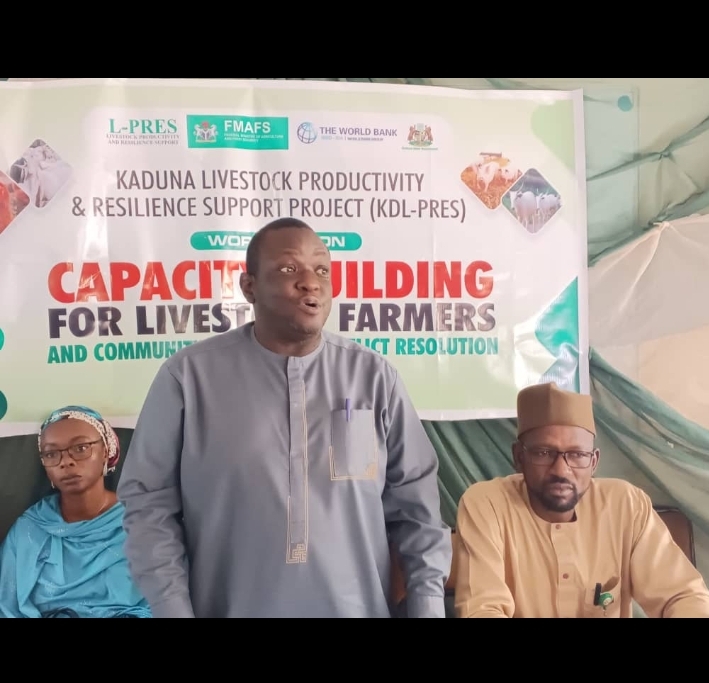
The Livestock Productivity & Resilience Support Project (L-PRES) has organized a capacity-building workshop for livestock farmers, community leaders, herders, and security officers on conflict management in Kaduna State.
The event was held at Arewa House, Kaduna, aimed at educating stakeholders on managing conflicts within their communities and also provided them with strategies to handle and resolve conflicts effectively.
Chairman of the State Steering Committee for L-PRES, Alhaji Abba Umar, who was represented by the Secretary of the State Steering Committee on Conflict Resolution, Mr. Amwe Akos, emphasized the importance of the training.
He urged participants to utilize the knowledge gained to enhance their conflict management skills.
Alhaji Abba noted that with proper conflict resolution skills, community clashes could be minimized.
“Herders and farmers’ clashes could be reduced to a minimal level through restraint and the intervention of community leaders. Where there is no peace, there will be no development,” he stressed.
Alhaji Abba Umar also highlighted that farmers sometimes face natural disasters that could be better managed with adequate conflict resolution strategies, underscoring the relevance of the training.
“We are in a situation where we face numerous environmental challenges and climate change. This training, which covers all senatorial zones in Kaduna State, is expected to bring significant relief. Participants are encouraged to share the knowledge acquired for the benefit of their communities,” he stated.
He added, “These representatives from various committees are expected to cascade the knowledge gained to their respective communities.”
According to him, the L-PRES project in Kaduna covers value chains including cattle, sheep, goats, piggery, and poultry, which may differ from other states. He explained that the steering committee was established by L-PRES and that the project is funded by the World Bank to improve productivity in the livestock sector and enhance resilience against shocks.
The forum expressed gratitude to the World Bank, the Federal Government, and Governor Uba Sani for their support.
In his remarks, the State Project Coordinator for L-PRES, Dr. Salisu Shittu Ashiru, represented by the Component Head of Conflict Mitigation, Musa Aba Adamu, encouraged participants to fully engage in the training to enhance their knowledge.
He emphasized his commitment to peace-building, stating, “On behalf of Kaduna L-PRES, I am honored to welcome you to this capacity-building training on conflict mitigation strategies. Today, we gather to address one of the pressing challenges of our time—conflict.”
Dr. Shittu described conflict as a troubling issue affecting individuals, communities, and the nation as a whole. He urged stakeholders to leverage the training to improve their conflict management skills.
“This capacity-building training is designed to equip you with the necessary skills and knowledge to mitigate conflicts in both personal and professional settings. Conflict is not inevitable; with the right skills, knowledge, and attitude, we can mitigate conflict and foster a more peaceful and resilient community,” he noted.
He emphasized that understanding the root cause of conflicts, active listening during mediation, and effective negotiation are essential skills for successful conflict resolution.
Alhaji Yusuf Bida, in his presentation on techniques for conflict prevention, effective communication, negotiation, and stakeholder engagement, outlined several strategies for achieving positive outcomes.
He emphasized that mediators must possess key qualities such as independence, resolution, patience, openness to constructive criticism, and above all, being God-fearing.
Hajiya Asmau Adamu, Deputy Director of Forestry and Resources at the Ministry of Environment and a member of the Conflict Resolution Committee, highlighted the importance of the training in enhancing peaceful coexistence between farmers and herders.
She noted that her ministry is actively working towards conflict resolution, with staff deployed to local government areas to monitor and address conflicts.
One of the participants, Mrs. Christiana Atama, a farmer specializing in millet, soybeans, and maize production, shared her experiences. She expressed her hope that the knowledge gained would help foster peace between farmers and herders, reducing the damage caused to farms by herders.
Community leader Alhaji Ibrahim Sarkin Gabas commended the government and organizers for facilitating the training, noting that “Farmers and herders are like twins.” He praised the initiative for promoting peaceful coexistence.
Cov/ Adamu Yusuf