The United Nations Children’s Fund (UNICEF) has urged policy makers in Nigeria’s education sector to take concrete measures to address socio-cultural, infrastructural and policy gaps that give rise to the high number of Out of School children in the country.
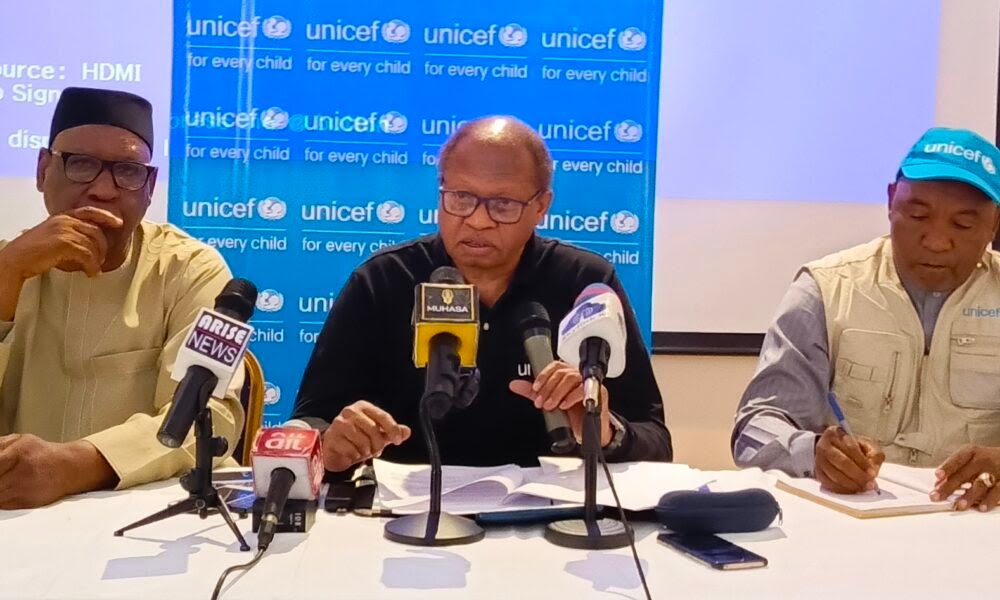
The UNICEF Chief of Kano Field Office, Mr. Rahama Rihood Farah, made the call at a press conference to mark the 2025 International Day of Education.
He noted that Kano, Jigawa and Katsina States have a total of 1,863,207 Out of School children at primary school level and 1,176,918 at junior secondary school level which he described as alarming.
He identified some challenges that sustain the Out of School phenomenon to include inadequate funding, poor supervision culture, inadequate school infrastructure, shortage of manpower and displacements due to flooding and other impacts of climate change.
“While Northwest Nigeria has the second highest out of school rates in Nigeria, the situation of out-of-school population in Kano, Jigawa and Katsina states is alarming.
“It is further exacerbated by poor learning outcomes for those children who are fortunate to be enrolled in school.
“There are currently about 10.2 million children at the primary level that are out of school in Nigeria, 16 per cent of them are from Kano, Jigawa and Katsina states, according to MICS 2021.
“Close to one million children are out of school in Kano state with a total of 989,234, Jigawa has a total of 337,861 while Katsina state has 536,112 out of school children”.
Mr. Farah highlighted some efforts by UNICEF to reverse the trend to include cash transfers, enrollment campaigns, integration of Quranic schools, donation of school infrastructure and learning and instructional materials as well as teacher training and support among others.
He urged the governments of Kano, Jigawa and Katsina States to match the budgetary appropriation with actual releases to the education sector in line with the SDG requirement and UNESCO benchmark for improved outcomes in the sector.
He also appealed to the governments of these states to tackle the challenge of access to education by expanding school infrastructure, recruiting more qualified teachers and integrating Quranic schools into the formal system.
“Across the states of Kano, Jigawa and Katsina, the UNESCO bench mark is being met and exceeded when it comes to appropriation.
“Unfortunately, budgetary appropriations to the education sector across these states have not been matched with actual release and spending of appropriated funds and this needs to be addressed.
“Tackle the challenge of access to education through initiatives that provide equitable access to education for out of school boys and girls.
“This can be achieved through platforms such as non-formal and Integrated Quranic Schools, digital and alternative learning pathways such as the Nigeria Learning Passport, radio and Community Learning hubs”, Farah said.
COV/Isma’il Adamu