
Adamu Yusuf
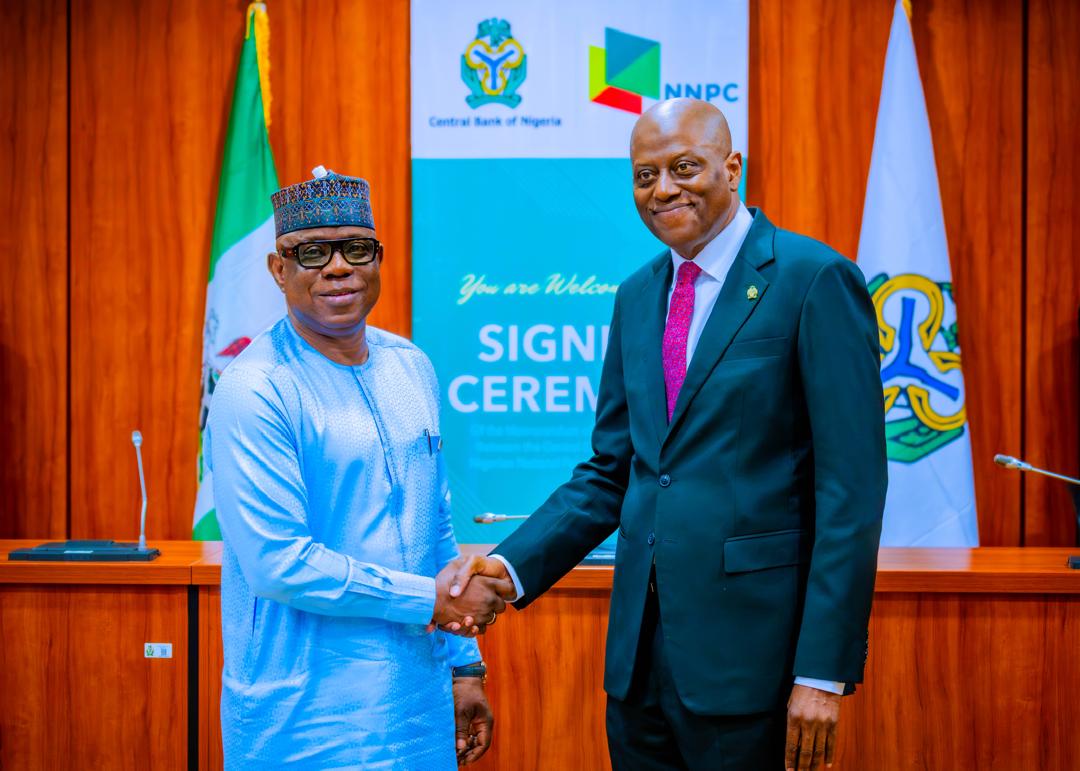
The Nigerian National Petroleum Company Limited (NNPC) and the Central Bank of Nigeria (CBN) have signed a Memorandum of Understanding to strengthen financial discipline, improve foreign exchange inflows and enhance financing for energy projects.
The agreement was signed at the CBN headquarters in Abuja as part of efforts to establish a structured partnership between the national energy company and the country’s monetary authority.
Speaking at the signing ceremony, the Group Chief Executive Officer of NNPC Limited, Bashir Bayo Ojulari, described the agreement as a defining moment, saying it would provide a clear framework for cooperation between both institutions at the intersection of energy and finance.
He explained that the partnership would align NNPC’s initiatives with national monetary and energy objectives, address challenges affecting trade and foreign exchange transactions, and facilitate the inflow of export proceeds into the Nigerian economy.
Ojulari added that the agreement would also enable NNPC to explore financial structures for raising capital based on its assets and balance sheet, with guidance from the CBN.
In his remarks, the Group Chief Financial Officer of NNPC Limited, Adedapo Segun, said the agreement would replace irregular financial arrangements with improved coordination, helping to attract investments needed to increase crude oil production from the current 1.8 million barrels per day to three million barrels per day.
He further explained that NNPC would align domestic payments, contractor settlements and foreign exchange conversions with CBN regulations to support the stability of the Naira and reduce dollarisation.
Segun disclosed that both institutions had agreed to establish working groups, implementation timelines and accountability mechanisms, with NNPC’s Treasurer, John Etukudo, overseeing the implementation on behalf of the company.
On his part, the CBN Governor, Olayemi Cardoso, described the agreement as a formalisation of an existing relationship, noting that continued cooperation in account management, funds transfer and liquidity support would contribute to macroeconomic stability and ensure predictable foreign exchange inflows.
Editing by Khadija Kubau