By Usman Muhammed Zaria
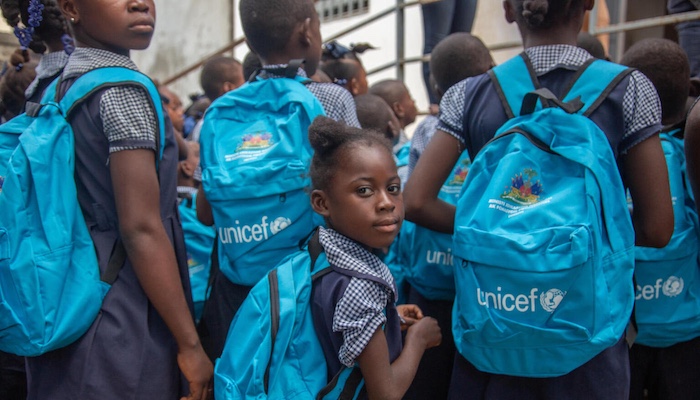
United Nations Children’s Fund (UNICEF), in partnership with the European Union and the Jigawa State Government, has commenced the implementation of an Accelerated Basic Education Programme (ABEP) aimed at providing learning opportunities for out-of-school children and adolescents across the state.
The programme, funded under the European Union’s Education and Youth Empowerment Programme in Northern Nigeria (EYEPINN), is being implemented through 135 learning centres across ten Local Government Areas of Jigawa State.
The intervention is designed to provide a second chance to children who have either never attended school or whose education has been interrupted, enabling them to acquire foundational literacy and numeracy skills and subsequently progress to formal education, vocational training or other appropriate learning pathways.
Speaking at the flag-off ceremony, Judith Leveillee, Chief of Field Operations and Emergency, UNICEF Nigeria, said the initiative represents an important step in the collective effort to ensure that every child, regardless of gender or circumstance, has access to safe, inclusive and relevant education.
Leveillee said education should not be regarded merely as a public service but as a fundamental right and the foundation for every child’s future.
She explained that the ABEP intervention was designed to address major categories of children affected by educational exclusion particularly those who were denied access and those who were delayed access to learning opportunities.
“By tackling these barriers, ABEP ensures that foundational literacy and numeracy skills become the cornerstone of every child’s learning journey,” she said.
According to her, the programme would also strengthen the capacity of teachers and facilitators to improve the quality of learning and ensure better outcomes for participating children.
Leveillee explained that the programme is particularly significant in communities where conventional schooling has not adequately reached children because of poverty, social barriers, distance, disability, displacement and other circumstances.
She pointed out that the programme uses an accelerated model through which learners can complete stages of learning and subsequently transition into formal education or skills development.
Meanwhile, the intervention which targets 80,000 out of school children, will establish 135 learning centres and engage 270 facilitators across 10 LGAs, with the objective of expanding access to basic education for marginalised children.
Our correspondent reports that the intervention in Jigawa State forms part of a broader EU-UNICEF education and youth empowerment initiative covering Jigawa, Kano and Sokoto states.
Editing By Yusuf Zubairu