Governor Umar Namadi has reaffirmed the Jigawa State Government’s commitment to ending street begging among children in the state.
He said every child deserves access to a conducive learning environment where they can acquire Qur’anic knowledge, modern education and vocational skills.
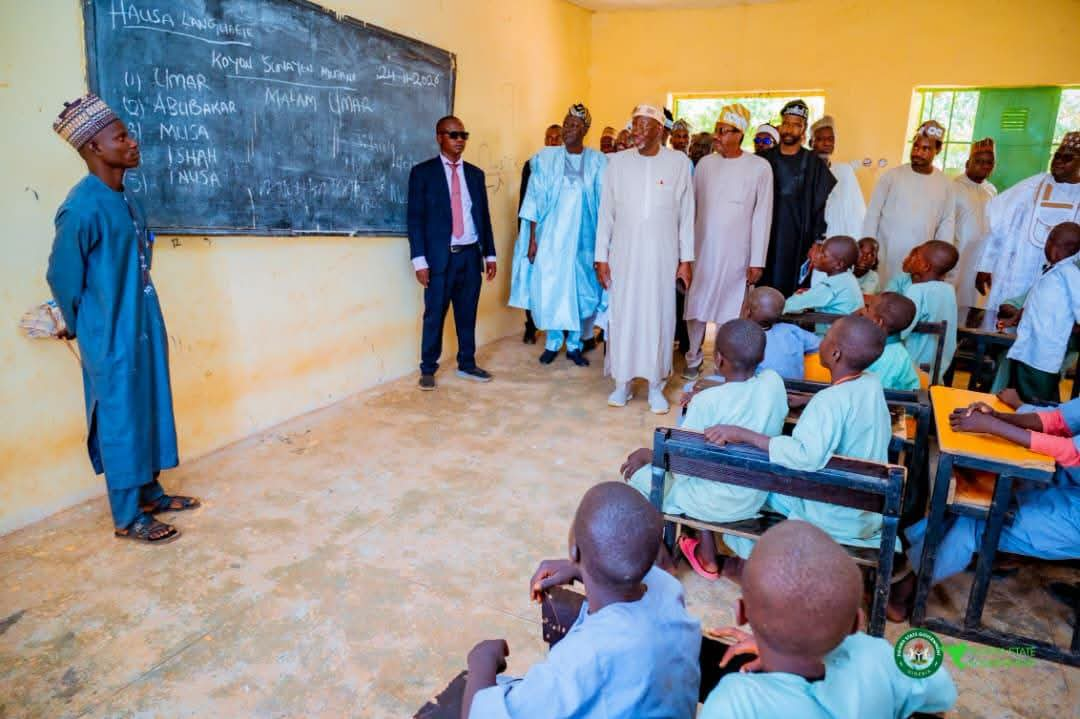
The governor made this declaration during a visit to Gwiwa Tsangaya Boarding Primary School in Gwiwa Local Government Area, as part of his state-wide campaign tour of the area.
Malam Umar Namadi explained that the establishment of the Jigawa State Tsangaya Education Board was informed by the need to recognise and strengthen Qur’anic education while creating opportunities for children receiving such education to have a secure and productive future.
He said that Qur’anic scholars possess valuable knowledge and should not be regarded as illiterates simply because their education follows a different path from the conventional Western system.
“Knowledge is knowledge. We cannot continue to leave these people unrecognised, nor can we ignore the future of the children under their care,” the governor said.
He pointed out that his administration was determined to harmonise Qur’anic education with modern education and vocational training, ensuring that children acquire both religious and formal education while developing practical skills that can support their livelihoods.
Namadi particularly commended the Alaramma’s (Qur’anic teachers) for their cooperation and support, noting that their involvement had been essential to advancing the Tsangaya reform initiative.
He assured that the government would provide suitable accommodation and learning facilities for children pursuing Qur’anic education so that they would no longer have to roam from place to place or engage in street begging.
“God willing, we will provide accommodation for every child who moves from place to place in search of Qur’anic education. We will ensure that no child in Jigawa State has to roam the streets begging. Every child should be in a learning environment, studying the Qur’an, receiving modern education, and acquiring vocational skills.”
Governor Namadi further reiterated his administration’s commitment to allocating substantial resources to the Tsangaya programme through successive annual budgets, adding that the initiative remains a government priority.
He also highlighted the introduction of the National Board for Arabic and Islamic Studies (NBAIS) programme as part of efforts to recognise Qur’anic learning and provide formal certification for those who have acquired substantial Qur’anic knowledge.
He also said the government would ensure that Alarammomi receive NBAIS certification after completing a programme lasting at least six months.
Malam Umar Namadi noted that individuals who have memorised the Qur’an deserve appropriate recognition of their knowledge, just as people who acquire qualifications through conventional educational institutions that receive certificates.
He reaffirmed that his administration would sustain its investment in Tsangaya education to ensure that children across Jigawa State have access to quality education, vocational opportunities and a future free from street begging.
Earlier, the Executive Secretary of the State Tsangaya Board, Abubakar Maje Hamisu, said the administration had recorded significant progress in Tsangaya education within its first three years.
He disclosed that the state government had established three new Mega Tsangaya Schools in Dutse, Ringim and Kafin-Hausa, which are nearing commissioning.
According to him, the government has also constructed 30 additional classrooms and 30 Qur’anic recitation halls in Tsangaya schools across the state, while employing 500 teachers under the J-Tsangaya programme.
Maje, added that, 277 Alaramma’s had been sponsored to participate in the NBAIS’s examinations in 2025 and 2026, respectively.
The Executive Secretary also cited the introduction of the Almajiri Begging-Free Zone Initiative, describing it as part of the administration’s broader efforts to improve the welfare, learning environment and future prospects of children in the Tsangaya system.
Editing By Yusuf Zubairu