
By Adamu Yusuf
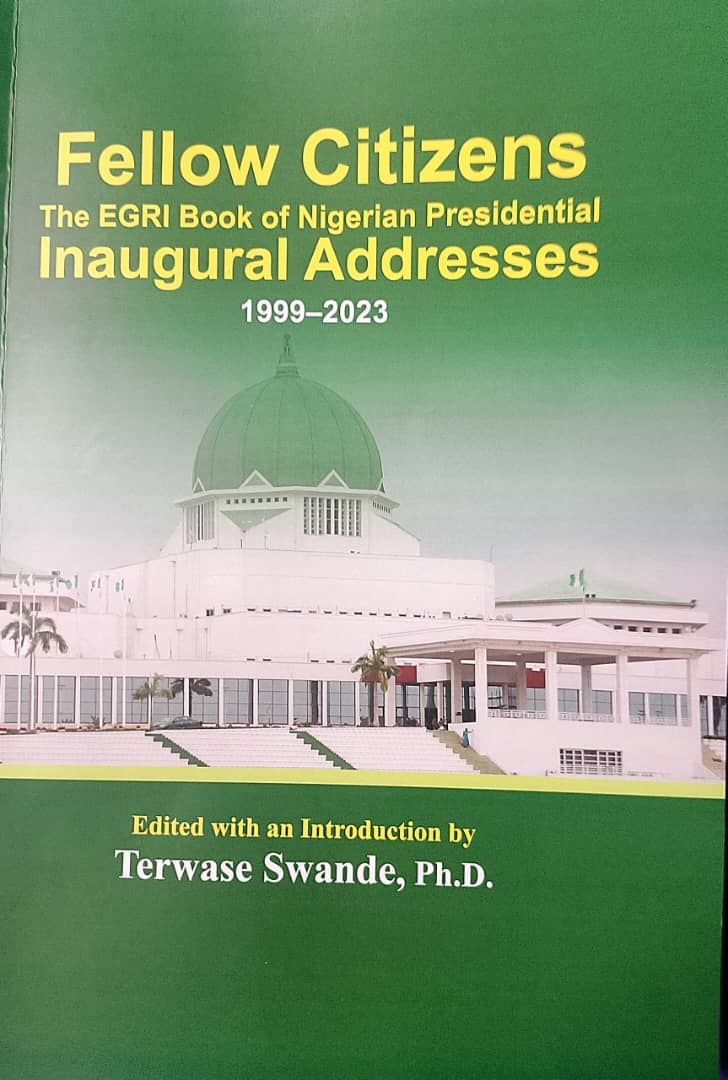
The Effective Governance Research Institute (EGRI) has published a book documenting Nigeria’s democratic journey through the inaugural addresses of its presidents from 1999 to 2023.
Edited with an introduction by Dr. Terwase Swande, the book presents the presidential speeches as a living archive of Nigeria’s democratic experience, capturing the hopes, challenges, policy priorities and national aspirations expressed at critical moments of political transition.
Titled Fellow Citizens: The EGRI Book of Nigerian Presidential Inaugural Addresses, 1999–2023, the publication brings together the inaugural addresses of the five presidents who have led Nigeria during the Fourth Republic.
Olusegun Obasanjo, Umaru Musa Yar’Adua, Goodluck Ebele Jonathan, Muhammadu Buhari and Bola Ahmed Tinubu.
The publication documents President Olusegun Obasanjo’s inaugural addresses of 1999 and 2003, highlighting his emphasis on restoring confidence in democracy, national reconciliation and collective responsibility after years of military rule.
It also examines President Umaru Musa Yar’Adua’s 2007 inaugural address, which acknowledged challenges surrounding the electoral process and emphasised due process, constitutionalism and institutional reform.
His Seven-Point Agenda was presented as a framework for addressing key national development priorities.
The book devotes attention to President Goodluck Ebele Jonathan, whose first inaugural address was delivered on May 6, 2010, following the death of President Yar’Adua. It also features his second inaugural address of May 29, 2011.
The publication highlights Jonathan’s emphasis on national unity, constitutionalism, security, economic recovery, institutional reform and democratic consolidation.
According to the book, Jonathan’s emergence as president represented another defining moment in Nigeria’s democratic process, particularly as the country navigated political succession following Yar’Adua’s death.
His addresses are presented as reflections of the country’s efforts to maintain political stability and strengthen democratic institutions.
The publication further examines Muhammadu Buhari’s inauguration in 2015, describing it as a significant milestone in Nigeria’s democratic history, as he became the first opposition candidate to defeat an incumbent president through a democratic election.
His inaugural address focused strongly on the fight against corruption, security and restoring public confidence in government.
It also includes Buhari’s second inaugural address of 2019, which addressed the country’s security challenges, economic development, infrastructure and democratic consolidation.
President Bola Ahmed Tinubu’s inaugural address of May 29, 2023, forms the latest chapter in the collection, reflecting the priorities and challenges confronting Nigeria at the beginning of his administration.
The book, according to its introduction, encourages Nigerians, researchers, policymakers and students to view presidential inaugural addresses not as isolated speeches, but as interconnected chapters in the country’s evolving democratic story.
Dr. Swande, who holds degrees in Accounting, Business Management and Finance and a PhD in Management from Reverend Father Moses Orshio Adasu University, Makurdi, is a Senior Manager with Fidelity Bank Nigeria and a Director and Senior Fellow of EGRI.
He has worked with several Nigerian banks, including the Standard Bank Group of South Africa, and has research interests in governance reforms, strategy, group dynamics and organisational design.
The publication describes the collection as an important resource for reflecting on Nigeria’s democratic progress since 1999 and the continuing quest for national development, good governance and democratic consolidation.